How to Build Muscle at Home Without Equipment (The Progression-Based Guide)
Can you build muscle at home without equipment?
Yes. Take every bodyweight set within 1–3 reps of failure and keep making each move harder over time. Research shows push-ups grow the chest and triceps about as well as bench press when effort is matched, and low-load training taken close to failure builds muscle on par with heavy lifting.
Train 3 days a week, cover every movement pattern with 10–20 hard sets per muscle per week, progress to tougher variations instead of adding weight, and eat 0.7–1 g of protein per pound of body weight. Expect 1–2 lbs of new muscle a month as a beginner.
Why Most “No Equipment” Advice Fails
Type “home workout for mass” into Google and you’ll get the same thing every time: a list of 12 exercises with a rep count next to each one. Do 15 push-ups, 20 squats, 30-second plank, repeat.
Here’s the problem. Those routines are designed so anyone can complete them, which is exactly why they stop building muscle after about three weeks.
Muscle grows in response to tension it isn’t used to. Once 15 push-ups become comfortable, doing 15 more tomorrow tells your body nothing new.
Gym lifters solve this by adding five pounds to the bar. At home, you have to solve it with position, tempo and leverage. That’s the skill this article teaches, and it’s the thing the ranking articles skip entirely.
The Science: Does Bodyweight Muscle Building Actually Work?
Let’s settle this with data rather than opinion.
In 2017, Japanese researchers Kikuchi and Nakazato put 18 untrained men through 8 weeks of training. One group did bench press at 40% of their one-rep max, the other did push-ups adjusted (kneeling, hands elevated) to match that same load.
Chest thickness rose 18.3% in the push-up group and 19.4% in the bench group. Triceps grew 9.5% and 10.3% respectively, and neither difference was statistically significant.
A year later, Kotarsky and colleagues tested a progressive push-up program against bench press in moderately trained men. Both groups got stronger, and the push-up group improved bench press 1RM about as much as the group actually bench pressing.
The bigger picture comes from Schoenfeld’s 2017 meta-analysis of 21 studies. When sets were taken to failure, loads of 60% 1RM or less produced the same hypertrophy as heavier loads. Heavy weight was better for maximal strength, but not for size.
A 2021 network meta-analysis by Lopez and colleagues covering 28 studies reached the same conclusion. Push close enough to failure, and load stops being the deciding factor.
The catch in every one of these studies: sets went to or near failure. Bodyweight muscle building works only if you’re willing to do the uncomfortable reps.
The 4 Rules of Building Muscle With No Gym
Rule 1: Every working set ends 1–3 reps shy of failure
Reps in reserve (RIR) is your new best friend. When you finish a set, ask yourself how many more clean reps you could have done.
If the honest answer is 4 or more, the set was too easy. Move up the progression ladder or slow the tempo.
Rule 2: Stay in the 6–25 rep range
Below 6 reps, you’re mostly training the nervous system. Above roughly 30, fatigue and boredom outrun muscle stimulus.
If you can do more than 25 reps of anything, it’s time for a harder variation. That single rule will keep you progressing for years.
Rule 3: Hit 10–20 hard sets per muscle per week
This is the same volume target we recommend in our complete guide to building muscle, and it doesn’t change because you’re at home. Three sessions of 3–4 sets per movement pattern gets you there.
Start at the low end. More is not better until you’ve recovered from what you’re already doing.
Rule 4: Progress something every week
Add a rep, add a set, slow the lowering phase, or move up the ladder. Log it in your phone’s notes app.
If you’re not writing it down, you’re guessing, and guessing is how people train for a year and look the same.
The Movement Patterns You Need to Cover
Forget “chest day.” Think in patterns, and make sure each one shows up in your week.
Vertical pull and hinge are where most home routines fall apart. Don’t skip them.
Progression Ladders for Every Exercise
Each ladder runs from easiest to hardest. Move up when you can do 3 sets of 20+ with 1–2 reps in reserve. Move down if you can’t get 6 clean reps.
Horizontal Push: The Push-Up Ladder
- Hands on kitchen counter
- Hands on a sturdy chair or couch arm
- Standard push-up (elbows at 45°, chest to floor)
- Feet elevated on chair
- Slow eccentric (4 seconds down) feet-elevated
- Archer push-up (one arm straight out to the side)
- One-arm push-up with hand elevated
- One-arm push-up on the floor
Tip: a slow 3–4 second lowering phase is the cheapest progression there is. Research on low-load training consistently shows that time under tension with high effort is what drives growth.
Vertical Push: The Pike to Handstand Ladder
- Pike push-up, feet on floor, hips high
- Pike push-up, feet on chair
- Pike push-up, feet on table
- Wall-facing handstand hold (30–60 seconds)
- Wall handstand push-up with a pillow under your head (partial range)
- Full wall handstand push-up
Shoulders respond very well to this ladder. Most men who’ve never trained overhead see visible delt growth within 6–8 weeks.
Horizontal Pull: The Row Ladder
- Towel row (loop a towel around a door handle, sit back, pull chest to hands)
- Inverted row under a sturdy table, knees bent
- Inverted row, legs straight
- Inverted row, feet elevated on a chair
- One-arm towel row
- Inverted row with 3-second pause at the top
Test any table before you hang off it. Dining tables with a central pedestal tend to tip; four-legged tables are safer.
Vertical Pull: The Pull-Up Problem (Solved)
You can’t fully replace pull-ups with nothing, but you can get close.
- Bedsheet pull-up: knot a sheet, close it in the top of a solid door, pull yourself up from a kneeling or lying position
- Door-frame hang and scapular pulls (if your frame has a lip)
- Negative pull-ups from a jump (lower for 5 seconds)
- Full pull-ups
Honest note: a $25 doorway pull-up bar is the single best dollar-for-dollar purchase in home training. If you stay strictly equipment-free, lean hard on the row ladder and the bedsheet version.
Squat: The Single-Leg Ladder
- Bodyweight squat, full depth
- Bulgarian split squat (rear foot on couch)
- Step-up onto chair, controlled descent
- Shrimp squat (hold rear foot, touch knee to floor)
- Assisted pistol squat (hold a door frame)
- Full pistol squat
Bulgarian split squats are the workhorse here. Done to 2 reps in reserve, they’ll leave your quads shaking harder than most leg-press sessions.
Hinge: The Hamstring Fix
This is the gap in almost every home program, and it’s why home-trained physiques often look top-heavy.
- Glute bridge, two legs
- Single-leg glute bridge
- Single-leg hip thrust, shoulders on couch
- Sliding leg curl (socks on hardwood, or towel on tile)
- Nordic curl, partial range (hook feet under couch)
- Full Nordic curl
Nordic curls are brutal and effective. Start with just the lowering portion, catching yourself with your hands.
Core
Hollow body holds, hanging or lying leg raises, and side planks cover it. Abs grow like any other muscle, so work them to near failure rather than holding a plank for 3 minutes.
Your 3-Day Home Workout for Mass
Run this for 8–12 weeks before changing anything. Rest 90 seconds to 2 minutes between sets, and pick the ladder step that lands you at 8–20 reps with 1–2 in reserve.
Day 1: Full Body A
Day 2: Full Body B
Day 3: Full Body C
Schedule it Monday/Wednesday/Friday or any three non-consecutive days. The two rest days in between aren’t optional; that’s when the growth happens.
How to Eat for Muscle When You Train at Home
Training supplies the signal. Food supplies the material, and no amount of push-ups overrides a diet that’s short on calories.
Calories
Aim for a surplus of 200–300 calories above maintenance. Any more than that and you’re mostly adding fat, which is easy to do when your kitchen is ten feet from your workout space.
Protein
Target 0.7–1 gram per pound of body weight daily, spread across 3–5 meals. For a 180-lb man, that’s 125–180 grams.
We break down exactly how to hit that number, with food examples and a calculator, in our guide on how much protein to build muscle.
Timing
Eat a protein-containing meal within a couple of hours on either side of training. Beyond that, total daily intake matters far more than the stopwatch.
Recovery: The Part That Actually Builds the Muscle
Your muscles get broken down during the workout and built back up while you sleep. Short yourself on sleep and you short yourself on gains.
Seven to nine hours is the target. Deep sleep is also when most of your body’s natural growth hormone is released, which we cover in detail in our article on how sleep affects HGH production.
Keep your rest days as actual rest days. A walk is fine; a “light” fourth workout because you feel guilty is not.
Building Muscle at Home After 40
Everything above still applies, with a few tweaks.
Warm up longer, and be more conservative with the Nordic curl and one-arm push-up progressions until your tendons have caught up with your muscles. Tendons adapt more slowly than muscle tissue, and that gap widens with age.
Recovery takes longer too, so a fourth rest day some weeks is smart, not lazy. Protein needs also edge up, toward the top of that 0.7–1 g/lb range.
We wrote a full, realistic guide on how to build muscle after 40 and 50 that pairs well with this program.
Common Mistakes That Stall Home Muscle Building
Chasing reps instead of difficulty. Fifty push-ups is a cardio achievement. Eight one-arm push-ups is a muscle-building one.
Skipping legs because they’re awkward. Bulgarian split squats and Nordic curls fix this. Awkward is not the same as ineffective.
Training every day. More frequency without more recovery just means you’re always half-recovered. Three hard days beat six mediocre ones.
Not eating enough. The most common reason home trainees “can’t build muscle” is a calorie intake that would struggle to maintain their current weight.
Never writing anything down. If you can’t tell me what you did last Wednesday, you can’t tell me whether you’ve progressed.
Best HGH Alternatives to Support Home Muscle Building
Let’s be clear up front: no supplement builds muscle without the training and food above. But recovery, sleep quality and body composition all lean on growth hormone, and natural output declines roughly 14–15% per decade after your twenties.
That’s where legal HGH alternatives fit. They don’t contain growth hormone, and they don’t work like injections. They’re amino acid and botanical blends designed to support your own production, mostly through the sleep and exercise-driven pulses your body already creates.
Based on our testing, three earn a place.
The Only 3 HGH Releasers Worth Stacking With Bodyweight Training
None contain real HGH and none replace the program above. They support your own growth-hormone pulses, mostly through sleep and training, and matter most after 40.


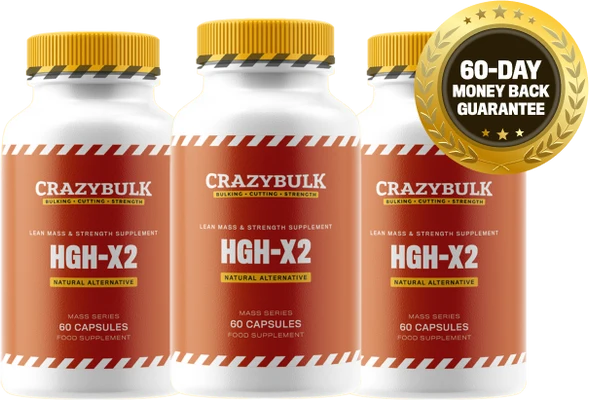
Full side-by-side ranking: Best Legal HGH Alternatives in the US. Dietary supplements, not medicines; they contain no human growth hormone. Affiliate links; confirm current prices on each official site.
When to Add Equipment (and What’s Worth It)
You can run the ladders above for a year or more. Eventually, though, the top rungs get very hard to progress past, especially for pulling.
If and when you decide to spend money, here’s the order that gives the most muscle per dollar: a doorway pull-up bar (around $25), a set of resistance bands ($20–40), then a weighted vest or a single pair of adjustable dumbbells. Everything else is optional.
Frequently Asked Questions
Can you really build muscle at home with no equipment? Yes. Multiple controlled studies show bodyweight exercises like push-ups grow muscle as effectively as barbell training when effort is matched. The key is training close to failure and progressing to harder variations.
How long does it take to see results from bodyweight training? Most beginners notice visible change in 6–8 weeks and meaningful size gain by 12 weeks. Expect 1–2 lbs of muscle per month early on, slowing over time.
How many days a week should I train at home? Three full-body sessions on non-consecutive days is ideal for most people. It hits every muscle twice-plus per week while leaving enough recovery time.
Is bodyweight training enough for legs? Yes, if you use single-leg variations. Bulgarian split squats, pistol progressions and Nordic curls load the legs far harder than two-footed squats ever will.
Can I build muscle at home in a calorie deficit? Beginners and people returning after a layoff sometimes can, for a while. For everyone else, a small surplus is needed for meaningful gains.
What’s the best no-equipment exercise for mass? There isn’t one. A push-up progression, a row progression, a single-leg squat and a hamstring hinge, all taken near failure, will build more than any single “best” move.
Do HGH supplements help you build muscle at home? Not directly. Legal HGH alternatives may support sleep, recovery and your body’s own growth hormone output, which in turn supports training. They’re a modest add-on, not a shortcut, and matter most after 40.
The Bottom Line
Building muscle at home without equipment isn’t a compromise; it’s a different set of tools. The research is clear that your muscles respond to effort and progression, not to what’s creating the resistance.
Train three days a week, take every set close to failure, and climb the progression ladders instead of hoping more reps will do the job. Eat enough protein, sleep like it’s part of the program, and give it 12 honest weeks.
Do that, and a floor, a chair and a door will build more muscle than most people get from a gym membership they use twice a month.
References
- Kikuchi N, Nakazato K. Low-load bench press and push-up induce similar muscle hypertrophy and strength gain. Journal of Exercise Science & Fitness, 2017. https://www.sciencedirect.com/science/article/pii/S1728869X17301028
- Kotarsky CJ, et al. Effect of progressive calisthenic push-up training on muscle strength and thickness. Journal of Strength and Conditioning Research, 2018. https://pubmed.ncbi.nlm.nih.gov/29466268/
- Schoenfeld BJ, Grgic J, Ogborn D, Krieger JW. Strength and hypertrophy adaptations between low- vs. high-load resistance training: a systematic review and meta-analysis. Journal of Strength and Conditioning Research, 2017. https://pubmed.ncbi.nlm.nih.gov/28834797/
- Lopez P, et al. Resistance training load effects on muscle hypertrophy and strength gain: systematic review and network meta-analysis. Medicine & Science in Sports & Exercise, 2021. https://pmc.ncbi.nlm.nih.gov/articles/PMC8126497/
- Schoenfeld BJ, Wilson JM, Lowery RP, Krieger JW. Muscular adaptations in low- versus high-load resistance training: a meta-analysis. European Journal of Sport Science, 2014. https://pubmed.ncbi.nlm.nih.gov/25530577/
- Carvalho L, et al. Muscle hypertrophy and strength gains after resistance training with different volume-matched loads. Applied Physiology, Nutrition, and Metabolism, 2022. https://cdnsciencepub.com/doi/abs/10.1139/apnm-2021-0515
- Effects of resistance training performed with different loads in untrained and trained male adults: a systematic review. IJERPH, 2021. https://www.ncbi.nlm.nih.gov/pmc/articles/PMC8582674/
Affiliate disclosure: this article contains affiliate links, and we may earn a commission if you buy through them, at no extra cost to you. It never affects our recommendations. Supplements discussed are not intended to diagnose, treat, cure or prevent any disease. Consult your doctor before starting any new training or supplement program.