Muscle Building for Skinny Guys (Hardgainer Guide)
How does a skinny guy build muscle? Eat 300–500 calories above maintenance every day — tracked, not guessed — with 0.7–1 g of protein per pound of body weight. Train three or four days a week on heavy compound lifts, adding weight or reps every session. Expect 1–2 lbs of gain per month; if the weekly scale average isn’t climbing, add 200 more calories. Nearly every “hardgainer” who stalls is under-eating, not under-training.
Key Takeaways
- Hardgainers are under-eaters, not genetic dead ends — track one honest week of food and the “fast metabolism” mystery usually solves itself.
- Eat 300–500 calories above maintenance daily with 0.7–1 g of protein per pound; if the weekly weight average isn’t climbing, add 200 and re-test.
- Liquid calories are the cheat code: one homemade 1,000-calorie shake daily closes the gap willpower can’t.
- Train 3–4 days on heavy compounds with 6–10 hard sets per muscle weekly, adding weight or reps nearly every session — recovery is your scarce resource, so spend it on quality.
- Skip the dirty bulk and the 6-day programs alike; both burn your margins for zero extra muscle.
- Expect 1–2 lbs a month and judge progress on the 12-week window, not the daily scale.
If you’ve ever been called skinny, eaten “a ton,” trained hard, and watched the scale refuse to move, this guide is yours. And it opens with a sentence that might sting.
You are almost certainly not eating what you think you’re eating. That’s not an insult — it’s the single most consistent finding when self-described hardgainers finally track a week of food, and it’s also the best news on this page.
Because it means the fix isn’t rare genetics or exotic programs. It’s a system for getting calories in when your appetite doesn’t want them — and that’s a solvable engineering problem.
The “Ectomorph” Question, Answered Honestly
Every guide on muscle building for ectomorphs treats the word like a diagnosis. Worth knowing: somatotypes come from a 1940s psychology framework, not modern physiology, and no gene sentences you to permanent skinniness.
What’s actually real about the skinny-guy experience is threefold. A naturally small appetite, a high level of unconscious daily movement that quietly burns extra calories, and a lighter bone structure that makes normal amounts of muscle look smaller.
Notice what all three have in common: they raise the calorie bar, and none of them stops muscle from growing once that bar is cleared. The research on muscle growth — protein thresholds, training volume, progressive overload — applies to your body exactly as written [1].
So we’ll use “hardgainer” in this guide to mean what it really means: someone who has to eat more deliberately than average. Nothing more fatalistic than that.
How to Gain Mass Skinny: The Eating System
Appetite is your bottleneck, so we don’t fight it with willpower — we route around it. Every tactic below reduces chewing, fullness, or effort per calorie.
Step 1: Find your real numbers
Multiply your body weight in pounds by 17–18 for a starting daily calorie target — skinny guys with high daily movement burn more than calculators assume. A 140-lb guy starts around 2,400–2,500 calories with 110–140 g of protein.
Then let the scale correct the math. Weigh in daily, average each week, and if two weeks pass without the average rising, add 200 calories — repeat until it moves.
Step 2: Drink what you can’t chew
Liquid calories bypass fullness signals, which makes the homemade shake the hardgainer’s best weapon. The classic: whole milk, two scoops of whey, a banana, two tablespoons of peanut butter, and a handful of oats — roughly 1,000 calories and 60 g of protein in five minutes.
One of those daily, on top of normal meals, closes most skinny guys’ entire gap. It’s cheaper than any mass gainer and you control every ingredient.
Step 3: Upgrade calorie density everywhere
Same plate, more calories: cook rice in butter, add olive oil to everything, choose whole milk over water, granola over plain cereal, and keep nuts within arm’s reach. Dried fruit, cheese, and dark chocolate are the snacks that pay rent.
What you’re not doing is the dirty bulk. Past a moderate surplus, extra calories buy fat rather than extra muscle — the goal is 300–500 over maintenance, consistently, not 1,500 over on chaotic weekends.
Step 4: Hit the protein floor
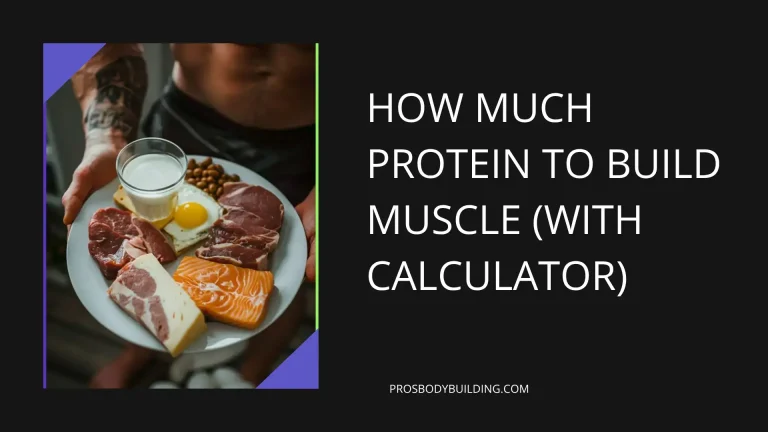
The muscle-building range is 0.7–1 g per pound of body weight daily, spread across 3–5 feedings [1]. Get your exact number in ten seconds with our protein calculator — then treat it as the one number you never miss.
The Hardgainer Workout: Less Than You Think, Heavier Than You’re Doing
Here’s where most skinny-guy programs get it backwards: they prescribe six days of high-volume training to someone whose problem is recovery resources, not effort. You grow between sessions, and a surplus-fed three-day program builds more than an under-fueled six-day one.
The template: three or four full-body or upper/lower days built on squats, deadlift variations, presses, rows, and pull-ups. Compounds recruit the most muscle per set, which matters enormously when your weekly set budget is modest.
Keep 6–10 hard sets per muscle per week to start — research shows meaningful growth begins well below the 10+ set volumes advanced lifters need [2]. You’ll add sets later, when you’ve earned the recovery capacity to use them.
The non-negotiable is progressive overload: log every session, and add weight or a rep nearly every week. That mechanic — the engine of our complete muscle-building guide — is the entire training side of this equation.
A sample hardgainer week
| Day | Session | Core Work |
|---|---|---|
| Mon | Full Body A | Squat, bench press, barbell row, curls |
| Tue | Rest + big shake | Walk if restless; eat like it’s your job |
| Wed | Full Body B | Deadlift, overhead press, pull-ups, core |
| Thu | Rest + big shake | Sleep 8 hours; groceries for the week |
| Fri | Full Body C | Front squat or leg press, incline press, row, arms |
| Sat–Sun | Life | Stay fed; skip long cardio sessions for now |
Cardio note, since skinny guys always ask: keep it to walking and the occasional short session while gaining. Every 400-calorie run is a shake you now owe yourself back.
What Progress Actually Looks Like (So You Don’t Quit at Week 6)
Months one to three: the scale climbs 3–6 lbs, your lifts jump fast, and nobody notices anything. This is the quitting window — don’t, because the visible phase is next.
Months three to twelve: 12–20 lbs total for most consistent beginners, shirts fitting differently, and the first “have you been working out?” comment. That first year is the fastest muscle you will ever gain, which is why wasting it on an untracked diet hurts so much.
Past year one, gains halve and halve again — that’s every natural lifter’s curve, not a hardgainer curse. If progress flat-lines despite honest tracking, work through the seven diagnostics in our muscle plateau guide before changing programs.
And one age note: this system works identically at 18 and 45, though recovery needs more respect with the years. If you’re a skinny guy past 40, pair this guide with the joint and protein adjustments in our building muscle after 40 guide.
Where Supplements Fit — and the Best HGH Alternatives
🧪 The Last-5% Experiment: Our 3 HGH Picks
For the over-40 lifter with training, protein and sleep already dialed — the three US formulas that publish every dose and back it with a real guarantee. Expectations set by this guide, not the ads.

GenF20 Plus
Sharpens: energy, skin and vitality for men over 40
- The only one with a clinical study on the finished product — 12 weeks, double-blind
- 16-ingredient tablet + Alpha-GPC spray
- Two-part system pushes the monthly cost up
HyperGH 14X
Sharpens: recovery and lean-mass support for men still training hard
- Dosed twice daily around both GH pulses — pre-training and at night
- 15+ ingredients, tablet + oral spray
- No clinical trial on the finished formula
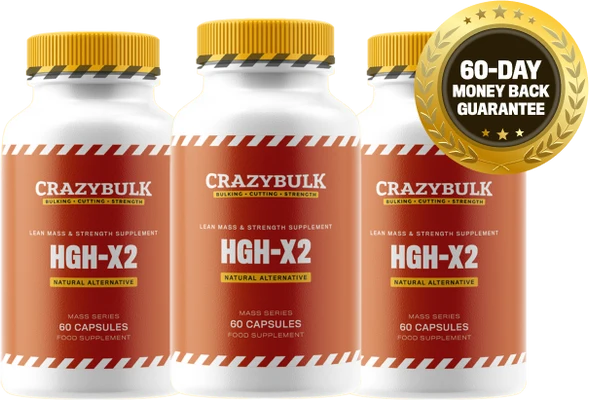
HGH-X2
Sharpens: the short-ingredient-list lane, and cutting phases
- Just four ingredients — arginine, maca, mucuna, hawthorn
- Simple dosing: four capsules before breakfast
- Fewest actives here, and CrazyBulk overclaims
The supplement industry loves hardgainers, because desperation shops generously. The honest hierarchy is short.
Creatine monohydrate first: 3–5 g daily is the most-proven muscle supplement in existence, and the couple pounds of water weight it adds is psychologically worth double to a skinny guy [3]. Whey protein second, as an ingredient for the shakes above rather than a magic powder.
Mass gainers? Read the label — they’re expensive whey and maltodextrin, and your blender makes a better one for a third of the price.
Then the aisle labeled growth hormone, which markets hard at skinny guys. The physiology worth knowing: no legal supplement contains actual HGH [4], and your biggest natural GH pulse fires during deep sleep — which a surplus-fed hardgainer sleeping 8 hours is already maximizing [5].
So-called HGH alternatives are amino-acid and botanical blends that aim to nudge your body’s own output at the margin. For a skinny guy who hasn’t fixed calories, they’re a wallet donation; for the over-40 reader with food, training, and sleep genuinely dialed, the three above at least publish every dose and back it with a real guarantee.
FAQ
Can a skinny guy really build muscle, or is it genetic?
Genetics set your rate and your frame, not your ceiling to a meaningful degree at beginner level. Every controlled study on the topic shows untrained men gaining muscle in a surplus with progressive training — skinny starters included, and often fastest in relative terms.
How many calories should a hardgainer eat?
Start at body weight in pounds × 17–18, then let two-week scale trends adjust it. The number that makes your weekly average climb by about half a pound is your number, whatever a calculator claimed.
What’s the best hardgainer workout split?
Three full-body days or a four-day upper/lower split, built on compounds with 6–10 hard sets per muscle weekly. More days only help once eating and recovery can fund them — which for most skinny guys is not yet.
Should skinny guys do cardio?
Walking, yes; long endurance sessions, not while gaining. Every extended cardio session widens the calorie gap that’s already your main enemy.
How long until a skinny guy sees results?
Strength moves within weeks; the mirror takes 10–12 weeks; other people notice around month four to six. The first year is the fastest gaining window of your life, so start the tracking today rather than January.
References
- Morton RW, et al. A systematic review, meta-analysis and meta-regression of the effect of protein supplementation on resistance training–induced gains in muscle mass and strength in healthy adults. Br J Sports Med. 2018;52(6):376–384. https://pubmed.ncbi.nlm.nih.gov/28698222/
- Schoenfeld BJ, Ogborn D, Krieger JW. Dose-response relationship between weekly resistance training volume and increases in muscle mass: a systematic review and meta-analysis. J Sports Sci. 2017;35(11):1073–1082. https://pubmed.ncbi.nlm.nih.gov/27433992/
- Kreider RB, et al. International Society of Sports Nutrition position stand: safety and efficacy of creatine supplementation in exercise, sport, and medicine. J Int Soc Sports Nutr. 2017;14:18. https://www.ncbi.nlm.nih.gov/pmc/articles/PMC5469049/
- Mayo Clinic — Human Growth Hormone (HGH): Does It Slow Aging? https://www.mayoclinic.org/healthy-lifestyle/healthy-aging/in-depth/growth-hormone/art-20045735
- Van Cauter E, Leproult R, Plat L. Age-related changes in slow wave sleep and REM sleep and relationship with growth hormone and cortisol levels in healthy men. JAMA. 2000;284(7):861–868. https://pubmed.ncbi.nlm.nih.gov/10938176/
This article is for educational purposes and isn’t medical advice. Check with a physician before significant changes to diet or training, particularly with existing health conditions — and if you’re gaining nothing despite a genuine tracked surplus, that’s worth medical investigation too. Dietary supplements are not FDA-approved to diagnose, treat, cure or prevent any disease, and our reviews contain affiliate links — we may earn a commission at no extra cost to you, which never affects our ratings.