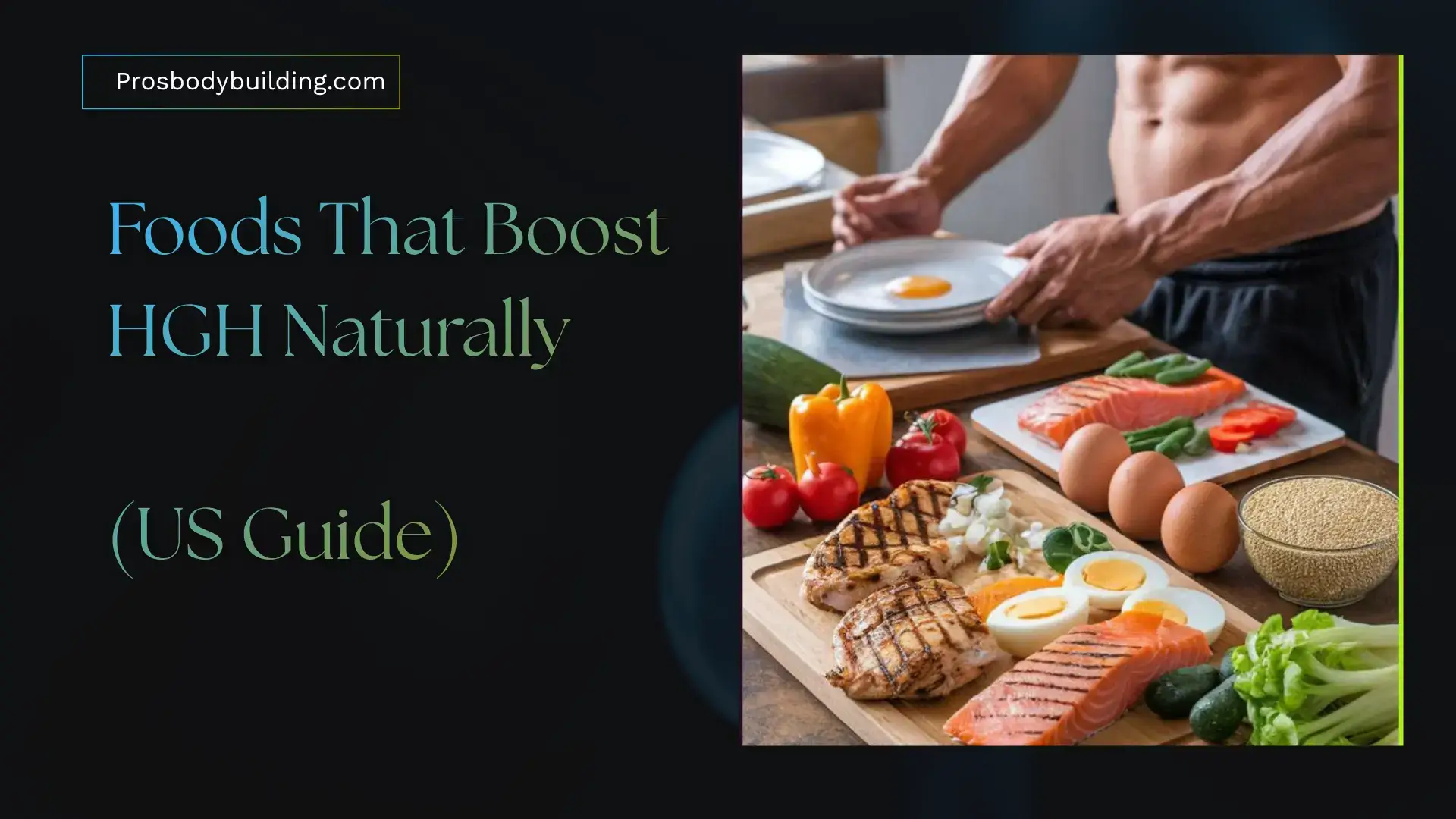
Foods That Boost HGH Naturally (US Guide)
I spent an afternoon reading the top-ranking articles on this topic. One recommends pineapple. Another says coconut oil keeps your growth hormone elevated for four hours. A third suggests raisins.
Several repeat a dosing figure that’s off by a factor of a thousand — and I’ll show you exactly where that error came from.
Here’s the honest version. No food raises growth hormone the way a fast or a sprint does. What food does is get out of the way, supply the raw material, and stop suppressing you.
That’s less exciting. It’s also true, and it’s actually actionable.
The 1,000x Error You’ll Find All Over the Internet
Let’s start here, because once you see it you’ll spot it everywhere.
Multiple high-ranking articles state that 2 mg of glutamine boosts growth hormone by up to 78%. It’s repeated on medical information sites, chiropractor blogs, and clinic pages.
Go to the actual study. Welbourne, American Journal of Clinical Nutrition, 1995.
The dose was two grams. Not two milligrams. That’s a thousand-fold difference.
Two milligrams of glutamine is roughly what you’d get from a single bite of chicken. It is a rounding error, not a dose.
It gets better
Read the study’s methods and the popular advice falls apart completely.
The two grams of glutamine were dissolved in a cola drink and taken 45 minutes after a light breakfast. Nine subjects, aged 32 to 64, single measurement window.
So the study that’s endlessly cited to justify “take glutamine before bed on an empty stomach, avoid carbs” actually administered it with sugar, after food, in the morning.
Nobody quoting it seems to have read past the abstract.
The same error, different amino acid
One ranking article recommends “15–20 mg of arginine per day” for a 60% increase in nighttime growth hormone.
The studies it’s referencing used 15–20 grams. Again, a thousand-fold error, sitting on page one of Google.
I’m not pointing this out to be smug. I’m pointing it out because it tells you how much of the “HGH foods” genre is copy-pasted rather than read — and it’s the reason this article exists.
What Food Actually Does for Growth Hormone
Four real mechanisms. None of them involve a superfood.
1. Insulin control — by far the biggest lever
Insulin is growth hormone’s direct antagonist. When insulin is elevated, GH release is suppressed. Full stop.
Which means the single most important thing your diet does for growth hormone isn’t what you add. It’s how hard and how often you spike your insulin.
A bowl of cereal at 10 p.m. does more damage to your GH output than a pound of pumpkin seeds does good.
2. Supplying raw material
Growth hormone signals your liver to produce IGF-1, and that whole axis is sensitive to protein intake and total energy availability.
Chronically under-eating protein suppresses IGF-1 regardless of how good your GH pulses are. This is the least glamorous item on the list and probably the second most important.
3. Correcting deficiencies
Vitamin D, zinc and magnesium all support the machinery. But correcting a deficiency is not the same as boosting a normal level.
If you’re already replete, more won’t help. That distinction gets erased in most food articles.
4. Reducing body fat
Visceral fat directly suppresses GH secretion. So the diet that gets you leaner does more for your growth hormone than any individual ingredient in it.
That’s the whole ballgame, and it’s why “which foods” is slightly the wrong question.
The Amino Acid Reality Check
This is where the food-versus-supplement distinction matters most, and where almost every list misleads you.
The amino acid studies used free-form powders, usually on an empty stomach, at doses you cannot realistically eat.
The Amino Acid Reality Check
What the studies actually used, versus what you’d have to eat to match it
| Amino acid | Dose used in research | What that means from food | Realistic? |
|---|---|---|---|
| Arginine The one every list recommends | 5–7 g15–20 g in the nighttime studies | About 4½ oz of pumpkin seeds — roughly 750 calories — and that’s the most arginine-dense food there is. From turkey you’d need close to a pound. | Not realistic |
| Glutamine Source of the 1,000× error | 2 gnot 2 mg, as widely misquoted | Genuinely achievable from a normal protein intake — but food glutamine arrives bound in protein and digested slowly, not free-form on an empty stomach. | Partly |
| Glycine Better sleep data than GH data | 3 gtaken before bed | Around 5–6 oz of gelatin-rich cuts — oxtail, shanks, chuck, skin-on chicken — or a decent mug of real bone broth. | Achievable |
| Ornithine Recommended via “eat more beef” | 2–6 gfree-form, post-exercise | Not meaningfully present in food at all. Your body makes it from arginine — which brings you straight back to the first row. | Not in food |
Two things this table is really telling you. First, free-form amino acids and protein-bound amino acids don’t behave the same way — a powder on an empty stomach hits your bloodstream fast, while the same amino acid inside a chicken breast arrives slowly alongside everything else in the meal. Second, the arginine advice is backwards regardless of dose: oral arginine taken before resistance exercise has been shown to blunt the growth hormone response rather than enhance it, which is the opposite of how every pre-workout markets it.
So when a list tells you to eat turkey “for the arginine,” understand what’s being implied. You’d need to eat about a pound of it, and the amount that reaches your bloodstream in free form is a fraction of the label number.
The 8 Foods Genuinely Worth Buying
None of these raise growth hormone directly — every one earns its place through a different route
| Food | How it helps | What it actually gives you |
|---|---|---|
| 1Eggs | Protein | Complete protein, choline, vitamin D and B12 for very little money. Two large eggs give you about 12g of protein for 140 calories. |
| 2Fatty fish | Deficiency fix | One of the few real dietary sources of vitamin D. A 3.5oz serving of sockeye covers most of a day. Canned sardines are cheaper and do a similar job. |
| 3Beef and lamb | Deficiency fix | Zinc, iron, B12, creatine and complete protein. Zinc is involved in pituitary function and runs low in men who train hard. Grass-fed makes almost no difference here. |
| 4Pumpkin seeds | Deficiency fix | Genuinely useful magnesium and zinc. Not for the arginine — you’d need 750 calories of them to reach a studied dose, as the table above shows. |
| 5Greek yogurt & cottage cheese | Protein | Slow-digesting casein, useful before bed if you want overnight protein without a large insulin spike. Cottage cheese wins if you’re watching carbs. |
| 6Tart cherries & kiwi | Sleep | Both contain melatonin and both have human data for better sleep quality. Arguably the best bet on this list, given how much of your daily GH output happens in deep sleep. |
| 7Bone broth & gelatin cuts | Sleep | Real dietary glycine — oxtail, shanks, chuck, skin-on chicken. Or just buy collagen powder; same amino acids, less simmering. |
| 8Leafy greens & cruciferous veg | Deficiency fix | Magnesium, folate, fibre and volume. Fibre blunts the glucose curve, which keeps insulin lower — and insulin is the mechanism that actually matters. |
Read the middle column again. Every food here works through protein, sleep or fixing a deficiency — not one of them talks to your pituitary. That’s the honest shape of this topic, and it’s why the foods that aren’t here (pineapple, coconut oil, raisins, fava beans) fail: they were never doing anything in the first place.
The Foods Genuinely Worth Buying
Here’s my actual list. Notice that most of them earn their place through sleep, protein or deficiency correction — not through a direct hormonal effect.
Eggs
Complete protein, choline, vitamin D and B12 in one cheap package. Two large eggs give you about 12 grams of protein for 140 calories.
They’re on every HGH list for vague reasons. They belong on this one for boring ones.
Fatty fish — salmon, sardines, mackerel
One of the few genuine dietary sources of vitamin D, which is worth caring about because deficiency is widespread in the US, particularly north of Atlanta’s latitude and among anyone who works indoors.
A 3.5 oz serving of sockeye salmon covers most of a day’s vitamin D. Canned sardines are cheaper and do a similar job.
Beef and lamb
Zinc, iron, B12, creatine and complete protein. Zinc deficiency is common in men who train hard and sweat a lot, and zinc is involved in pituitary function.
Grass-fed versus grain-fed makes almost no difference to any of this. Buy whichever you’ll actually cook.
Pumpkin seeds
The highest arginine density of any common food, plus a genuinely useful amount of magnesium and zinc.
I’m including them with the caveat above: you’re not hitting a pharmacological arginine dose from a handful. You are getting magnesium, which supports sleep, which is where your real GH lives.
Greek yogurt and cottage cheese
Slow-digesting casein protein, useful before bed if you want protein overnight without a large insulin spike.
Cottage cheese is the better pick if you’re watching carbs — plain Greek yogurt varies a lot by brand.
Tart cherries and kiwi
Both contain melatonin, and both have some human data for improved sleep quality.
This is an indirect route, but given how much of your daily growth hormone output happens during deep sleep, it’s arguably a better bet than any amino acid on this list. We go through that mechanism in detail in our guide to how sleep affects HGH production.
Bone broth and gelatin-rich cuts
Real dietary glycine, which has modest data for improving subjective sleep quality and reducing time to fall asleep.
Oxtail, shanks, chuck, chicken with the skin and bones. Or just buy the collagen powder — it’s the same amino acids and it’s cheaper than making broth.
Leafy greens and cruciferous vegetables
Magnesium, folate, fiber and volume. Fiber blunts the glucose curve, which keeps insulin lower, which is the mechanism that actually matters.
Spinach, kale, broccoli, Brussels sprouts. Nothing exotic.
Timing Beats Ingredients
If you only change one thing about how you eat, change this.
Stop eating three hours before bed. Two reasons, and the first is specific to growth hormone.
Your largest GH pulse of the day fires shortly after sleep onset. Elevated insulin at that moment blunts it.
Second, digestion raises your core body temperature, and your core temperature needs to drop to initiate deep sleep.
The evening carb rule
Front-load your carbohydrates around training, where your muscles are most insulin-sensitive and the carbs actually do something.
Then keep the evening low. Refined carbs and sugar within three hours of bed are the single most avoidable dietary mistake in this whole topic.
A bowl of ice cream at 10 p.m. costs you more than its calories.
Meal spacing
Every meal raises insulin. So constant grazing means constantly suppressed growth hormone.
Three meals with real gaps between them does more for your GH profile than six small ones, even at identical calories. This is also the mechanism behind why fasting increases HGH so dramatically — though there’s an important catch to that story worth reading before you build a protocol around it.
A quick note on protein before bed
Casein before bed is fine and probably useful for muscle. Just know that protein does raise insulin, modestly.
If your goal is purely maximizing the sleep-onset GH pulse, an empty stomach beats a protein shake. If your goal is body composition overall, the shake is probably the better trade. Pick your priority rather than pretending there isn’t one.
What About Dairy and IGF-1?
A fair question, and one most articles skip.
Dairy consumption does modestly raise circulating IGF-1 in humans. If IGF-1 is what drives growth hormone’s anabolic effects, that sounds like a straightforward win.
It’s more complicated. Epidemiological research has linked higher IGF-1 levels with increased risk of certain cancers — the associations are consistent enough to take seriously but far from proof of causation.
My honest read: normal dairy intake as part of a varied diet is fine, and the protein and calcium are genuinely useful. Deliberately loading dairy to spike IGF-1 is a strategy with unquantified downside and modest upside.
I wouldn’t build a plan around it in either direction.
The “HGH Foods” That Are Pure Fiction
Being direct about what’s circulating.
Pineapple. Recommended for vitamin C and manganese, with a hand-wave toward serotonin. There is no meaningful evidence pineapple affects growth hormone.
Coconut oil. One widely-copied article claims it keeps GH elevated for four hours. I could not find a study supporting this. It appears to trace back to nothing.
Raspberries, raisins and goji berries. These appear on lists that also promise height increases in children. That should tell you enough about the source.
Fava beans. Popular because they contain L-dopa. The leap from L-dopa to meaningful GH elevation from a normal serving is not supported.
“Alkaline” foods. The Welbourne study did find raised bicarbonate alongside raised GH, which is where this comes from. That’s a long way from a food-based alkalinity strategy.
None of these foods are bad for you. Eat the pineapple if you like pineapple. Just don’t expect a hormonal response from it.
Foods and Habits That Actively Suppress GH
Worth knowing what’s working against you.
Alcohol. In a controlled study, alcohol suppressed plasma growth hormone by 70–75% — and notably, this happened even though slow-wave sleep increased. The suppression appears to be direct rather than a sleep-quality effect, which means you can’t out-optimize it with a better bedtime routine.
Late-night refined carbs. Covered above. The worst-timed insulin spike you can produce.
Chronic overeating. Visceral fat directly suppresses GH secretion, and the relationship compounds — low GH makes visceral fat easier to store.
Constant snacking. Insulin never comes back down, so the brake is never fully released.
Under-eating protein. Suppresses IGF-1 regardless of what your GH pulses are doing.
A Realistic Day of Eating
Not a meal plan — an illustration of the principles.
Break your fast around noon. Three eggs, spinach, half an avocado. Protein and fat, minimal insulin response, and you’ve extended your overnight fasting window by four hours without trying.
Mid-afternoon, around training. This is where carbs belong. Rice, potatoes, oats — whatever you like — alongside a solid protein source.
Dinner by 6 or 7 p.m. Salmon or beef, a large pile of vegetables, moderate starch. Finished at least three hours before bed.
If you need something later. Cottage cheese, or nothing. Not cereal, not toast, not ice cream.
Throughout. Water, black coffee before 2 p.m., and keep the alcohol occasional rather than nightly.
That’s it. No pineapple required.
Where Food Ranks Among the Levers
Let me put this in proportion, because I think it’s the most useful thing in the article.
Ranked by how much they actually move growth hormone:
- Sleep — roughly 70% of your daily output happens during early sleep
- Body fat — visceral fat directly suppresses secretion
- Training intensity — the largest acute spikes come from sprint work and short-rest lifting, which we cover in our guide to the exercises that boost growth hormone
- Fasting windows — dramatic acute effects, with caveats
- Food choices — supportive, corrective, indirect
Food is fifth. That’s not a reason to ignore it, but it is a reason to fix the first four before you reorganize your grocery list.
For how all five fit together, our pillar guide covers how to increase HGH naturally in full.
Do You Need Supplements?
Short answer: not if the fundamentals aren’t handled.
Three things have real human data at doses you’d struggle to eat — glycine at 3 g, magnesium in the evening, and GABA at 3 g, which produced a substantial acute GH elevation in a placebo-controlled crossover trial in resistance-trained men.
All three are cheap and low-risk. None of them substitutes for sleep, training or losing visceral fat.
And no oral product contains actual growth hormone — it’s a protein, and your stomach destroys it. If you’re evaluating commercial formulas, our breakdown of the best legal HGH alternatives goes through which ones disclose their doses honestly and which are selling a story.
Frequently Asked Questions
What foods increase growth hormone the most?
No single food raises growth hormone meaningfully. What matters is adequate protein, controlled insulin — especially in the evening — and enough total energy to support the GH/IGF-1 axis. Foods that improve sleep, like tart cherries, may help more indirectly than any amino acid source.
Does eating before bed lower HGH?
It can. Your largest daily GH pulse fires shortly after sleep onset, and elevated insulin blunts it. Aim to finish eating about three hours before bed, and keep refined carbs out of that window especially.
Is the “2 mg of glutamine boosts HGH 78%” claim true?
No. The study behind that claim used two grams, not two milligrams — a thousand-fold error that’s been widely copy-pasted. The glutamine was also dissolved in a cola drink and taken after breakfast, which contradicts the “empty stomach before bed” advice usually attached to it.
Can I get enough arginine from food to raise HGH?
Realistically, no. The research used 5–7 grams of free-form arginine, and up to 15–20 grams in the nighttime studies. Getting that from food would mean roughly 750 calories of pumpkin seeds — and arginine taken before training has been shown to blunt the GH response anyway.
Does milk increase growth hormone?
Dairy modestly raises IGF-1 rather than growth hormone itself. Normal intake is fine and the protein is useful, but deliberately loading dairy to raise IGF-1 has unclear long-term implications.
The Bottom Line
Most of what you’ll read about HGH foods is copied from other articles, and at least one widely-repeated number is off by a factor of a thousand.
Here’s what’s real. Food’s biggest effect on growth hormone runs through insulin, not through any special ingredient. Keep the evening low in refined carbs, leave three hours before bed, and stop grazing all day.
Eat enough protein to support the axis. Fix vitamin D, zinc and magnesium if you’re short. Lose the visceral fat.
The eight foods on my list earn their place through protein, sleep support and deficiency correction — not because any of them talks to your pituitary.
And if a list recommends pineapple for your growth hormone, close the tab.
One change to make this week: move dinner earlier and cut the late-night snack. That does more than every food on this page combined.
This article is for informational purposes and is not medical advice. Consult a physician or registered dietitian before making significant dietary changes, particularly if you have diabetes, kidney disease, or take medication affecting blood sugar.
References
Amino acids and growth hormone
- Welbourne TC. Increased plasma bicarbonate and growth hormone after an oral glutamine load. Am J Clin Nutr. 1995;61(5):1058–1061. PMID 7733028. — https://pubmed.ncbi.nlm.nih.gov/7733028/
- Full text of the above (AJCN). — https://ajcn.nutrition.org/article/S0002-9165(23)18785-5/pdf
- Gleeson M. Dosing and efficacy of glutamine supplementation in human exercise and sport training. J Nutr. 2008;138(10):2045S–2049S. — https://jn.nutrition.org/article/S0022-3166(22)09697-3/fulltext
- Collier SR, Collins E, Kanaley JA. Oral arginine attenuates the growth hormone response to resistance exercise. J Appl Physiol. 2006;101(3):848–852. — https://pubmed.ncbi.nlm.nih.gov/16741262/
- Forbes SC, Harber V, Bell GJ. Oral L-arginine before resistance exercise blunts growth hormone in strength-trained males. Int J Sport Nutr Exerc Metab. 2014;24(2):236–244. — https://pubmed.ncbi.nlm.nih.gov/24225560/
- Marcell TJ, et al. Oral arginine does not stimulate basal or augment exercise-induced GH secretion in either young or old adults. J Gerontol A Biol Sci Med Sci. 1999;54(8):M395–M399. — https://pubmed.ncbi.nlm.nih.gov/10496544/
- Powers ME, Yarrow JF, McCoy SC, Borst SE. Growth hormone isoform responses to GABA ingestion at rest and after exercise. Med Sci Sports Exerc. 2008;40(1):104–110. — https://pubmed.ncbi.nlm.nih.gov/18091016/
Insulin, body fat and GH suppression
- Growth hormone deficiency in patients with obesity. Endocrine. 2015. — https://link.springer.com/article/10.1007/s12020-015-0571-4
- Rasmussen MH. Obesity, growth hormone and weight loss. Mol Cell Endocrinol. 2010. — https://www.sciencedirect.com/science/article/abs/pii/S0303720709004377
Sleep, alcohol and diet timing
- Van Cauter E, Plat L. Physiology of growth hormone secretion during sleep. J Pediatr. 1996. — https://www.jpeds.com/article/S0022-3476(96)70008-2/fulltext
- Prinz PN, Roehrs TA, Vitaliano PP, et al. Effect of alcohol on sleep and nighttime plasma growth hormone and cortisol concentrations. J Clin Endocrinol Metab. 1980;51(4):759–764. — https://pubmed.ncbi.nlm.nih.gov/7419664/
Fasting and the GH/IGF-1 axis
- Hartman ML, Veldhuis JD, Johnson ML, et al. Augmented growth hormone secretory burst frequency and amplitude mediate enhanced GH secretion during a two-day fast in normal men. J Clin Endocrinol Metab. 1992;74(4):757–765. — https://pubmed.ncbi.nlm.nih.gov/1548337/
- Nørrelund H. The metabolic role of growth hormone in humans with particular reference to fasting. Growth Horm IGF Res. 2005;15(2):95–122. — https://www.sciencedirect.com/science/article/abs/pii/S1096637405000201
Claims corrected in this article
- MedicineNet. Human growth hormone: 13 ways to increase HGH naturally. — https://www.medicinenet.com/human_growth_hormone_13_ways_to_increase_hgh/article.htm