How To Cut Body Fat – 12 Proven Startegies That Actually Work
Yet for all the diets, trends, and “miracle” supplements flooding the market every year, most people still don’t know how to cut body fat effectively.
I get it.
It’s overwhelming out there.
Keto. Intermittent fasting. Ice baths. Fat burners. Everyone has an opinion, and half of them contradict each other. So in this guide, I’m cutting through the noise (pun intended) and giving you a clear, research-backed roadmap to losing body fat without sacrificing your health, your energy, or your muscle mass.
Whether you’re a complete beginner or someone who’s been grinding in the gym for years and just can’t crack that last layer of fat — this is for you.
Let’s get into it.
The Real Meaning of Cutting Body Fat?
Before we talk strategy, we need to get clear on what body fat actually is — because most people confuse it with body weight, and that confusion leads to a lot of wasted effort.
Your body weight is the total mass of everything inside you: muscle, bone, water, organs, and fat.
Body fat is just one piece of that puzzle.
When people say they want to “lose weight,” what they almost always mean is they want to lose fat — not muscle, not water, not bone density.
That distinction matters more than most people realize. Your body fat percentage is the proportion of your total weight that comes from fat tissue.
A fit, healthy man might carry 12–18% body fat.
A fit, healthy woman might be somewhere between 18–25%.
Elite athletes? Often well below 10% for men and 16% for women.
Now here’s something a lot of people don’t know: not all fat is created equal.
There are two main types to understand.
The first is subcutaneous fat — this is the fat you can pinch, the soft layer sitting just beneath your skin.
It’s the stuff you see in the mirror.
It’s not particularly dangerous to your health in moderate amounts, but it is the most visible, and it’s what most people want to reduce.
The second type is visceral fat — this one is the real troublemaker.
Visceral fat wraps around your internal organs, deep in your abdominal cavity.
You can’t always see it from the outside.
But it’s strongly linked to type 2 diabetes, heart disease, high blood pressure, and metabolic dysfunction.
The good news?
The strategies that reduce one type almost always reduce the other.
So when people say they want to “lose belly fat,” they’re really talking about both — the visible layer and the dangerous deeper layer.
Here’s one more important thing to understand before we dive in.
The scale is not your best friend during a fat loss journey.
It can’t tell the difference between fat, muscle, and water.
You can lose two pounds of fat in a week while simultaneously gaining a pound of muscle and retaining a pound of water — and the scale will just say “no change.”
This is why tracking body fat percentage, progress photos, and how your clothes fit will serve you far better than obsessing over a number that only tells you part of the story.
Create a Caloric Deficit — The Foundation of Every Fat Loss Plan
If there’s one thing every credible nutrition expert agrees on, it’s this: you cannot lose body fat without a caloric deficit.
Full stop.
Everything else in this guide is important.
But without a deficit, none of it works.
A caloric deficit simply means consuming fewer calories than your body burns in a given day.
When that happens, your body needs to find energy from somewhere else — and it turns to stored body fat.
That’s the entire mechanism.
The magic number most people need to figure out first is their TDEE — Total Daily Energy Expenditure.
This is how many calories your body burns in a typical day, factoring in your basal metabolic rate (the calories your body burns just to stay alive) plus the energy you expend through movement and exercise.
You can find free TDEE calculators online in about 30 seconds.
Just input your age, height, weight, and activity level, and it gives you a starting estimate.
Once you know your TDEE, you subtract calories from it to create your deficit.
The sweet spot most experts recommend?
Somewhere between 300 and 500 calories below your TDEE per day.
At that rate, you’re looking at roughly 0.5 to 1 pound of fat loss per week — which sounds slow, but adds up to 25–50 pounds over a year without destroying your metabolism or your sanity.
Now, you might be wondering: why not just cut 1,000 calories a day and lose weight twice as fast?
Here’s what happens when you do that.
Your body is smarter than you think.
When it senses a massive drop in calorie intake, it interprets that as a famine signal.
In response, it downregulates your metabolism — meaning it starts burning fewer calories to conserve energy.
It also spikes hunger hormones, breaks down muscle tissue for fuel, and makes you feel miserable.
You might lose weight fast in week one, but by week three or four, the scale has stalled, you’ve lost muscle, and you feel exhausted and irritable.
This is called metabolic adaptation, and it’s one of the most common reasons diets fail.
A moderate, steady deficit avoids all of that.
It keeps your metabolism ticking, your energy stable, and your muscle intact.
For tracking your intake, apps like MyFitnessPal, Cronometer, or Lose It are genuinely useful — not because you need to track calories forever, but because doing it for even four to six weeks builds an incredibly accurate intuition for how much you’re actually eating.
Most people are shocked to discover what a “normal” serving size actually looks like.
Prioritize Protein to Preserve Muscle While Cutting Fat
If the caloric deficit is the engine of fat loss, protein is the seatbelt.
It protects everything you’ve built while your body is in the process of losing fat.
Here’s why this matters so much.
When you eat fewer calories than you burn, your body can choose to pull energy from fat stores — or it can break down muscle tissue.
The factor that most determines which one it chooses?
How much protein you’re eating.
A high protein intake sends a clear signal to your body: “We still need this muscle. Keep it.”
Low protein during a deficit sends the opposite message.
For most people looking to lose fat while maintaining muscle, research supports eating somewhere between 0.8 and 1.2 grams of protein per pound of bodyweight per day.
If you weigh 180 pounds, that’s 144 to 216 grams of protein daily.
That might sound like a lot.
And honestly, for most people who haven’t paid attention to protein before, it is.
But it’s absolutely achievable with the right food choices.
The best high-protein, low-calorie foods to build your diet around include chicken breast, turkey breast, white fish like tilapia and cod, canned tuna, egg whites, Greek yogurt, cottage cheese, and lean beef.
Whey protein powder is also useful as a convenient top-up when you’re running short.
There’s another bonus to eating more protein that most people overlook.
It has the highest thermic effect of any macronutrient.
That means your body burns more calories just digesting and processing protein compared to carbs or fat — roughly 20–30% of protein’s calories are burned during digestion, versus about 5–10% for carbs and just 0–3% for fat.
So a high-protein diet is quietly increasing your calorie burn on top of everything else.
And protein is extraordinarily filling.
It suppresses hunger better than any other macronutrient, which makes sticking to a caloric deficit a significantly less painful experience.
When you’re eating enough protein, you’re rarely starving.
The Role of Strength Training in Fat Loss
Here’s something that surprises a lot of people when they first hear it: cardio is not the most effective way to lose body fat.
Resistance training is.
Or more specifically, a combination of the two — but with strength training as the foundation.
The reason comes down to what happens to your metabolism when you build muscle.
Every pound of muscle you carry burns roughly six calories per day at rest.
Fat tissue, by comparison, burns about two calories per day per pound.
That doesn’t sound like a huge difference — but over time, it adds up to a meaningful increase in your resting metabolic rate.
In practical terms: the more muscle you have, the more calories your body burns even when you’re sitting still, sleeping, or just going about your day.
This is why crash dieters who lose weight through calorie restriction alone — without resistance training — often end up “skinny fat.”
They’re lighter on the scale, but they’ve lost muscle alongside the fat, which has actually lowered their metabolism and made it harder to stay lean going forward.
Strength training prevents that.
It sends a strong signal to your body that muscle is needed and should be preserved, even in a caloric deficit.
The most effective training approaches for fat loss focus on compound movements — exercises that recruit multiple large muscle groups simultaneously.
Think squats, deadlifts, bench press, bent-over rows, pull-ups, and overhead press.
These moves burn more calories per session than isolation exercises like bicep curls and deliver a much larger hormonal stimulus for fat burning.
For most people, three to five strength training sessions per week hits the sweet spot.
You don’t need to live in the gym.
You just need to be consistent and progressive — gradually adding weight or reps over time to keep the stimulus challenging.
One important mindset shift: don’t change your training style when you start cutting.
A lot of people switch to “light weights, high reps” the moment they want to tone up.
This is a mistake.
Heavy, progressive training is what built your muscle.
It’s also what keeps it.
The stimulus needs to stay strong.
Cardio for Fat Loss — How Much Is Enough?
Cardio has a complicated reputation in the fitness world.
Some people swear by it. Others think it’s useless for fat loss. The truth, as usual, is somewhere in the middle.
Cardio is a useful tool for creating additional caloric expenditure — meaning it helps you burn more energy without having to eat less.
That’s valuable when you’re already eating as little as feels sustainable. But it needs to be used strategically, not just piled on endlessly. The two main types of cardio used for fat loss are LISS and HIIT.
LISS stands for Low-Intensity Steady-State — think incline walking, cycling at a moderate pace, or a relaxed jog.
It’s easy to recover from, doesn’t compete aggressively with strength training, and can be done frequently without burning you out.
For most people, 3–4 sessions of 30–45 minutes per week is a solid starting point.
HIIT stands for High-Intensity Interval Training — alternating short bursts of all-out effort with recovery periods.
It burns a significant number of calories in a shorter time and has a modest “afterburn” effect where your metabolism stays elevated for hours after the session.
The downside is it’s taxing on the body.
If you’re also lifting weights four or five times a week and eating in a deficit, stacking heavy HIIT on top can push recovery past its limit.
Use it sparingly — one to two sessions per week at most.
Now, here’s a concept that doesn’t get nearly enough attention: NEAT.
NEAT stands for Non-Exercise Activity Thermogenesis.
It’s the energy you burn through all the movement in your day that isn’t formal exercise — walking to your car, fidgeting, taking the stairs, pacing while on the phone.
For many people, NEAT accounts for more calorie expenditure than all their gym sessions combined.
Studies have found that NEAT can vary by up to 2,000 calories per day between individuals.
This is why some people seem to eat endlessly without gaining weight — they’re just naturally more fidgety and active throughout the day.
The practical takeaway?
Increasing your daily step count — even just aiming for 8,000–10,000 steps per day — can create a significant calorie deficit without any formal exercise.
On the topic of fasted cardio: the idea is that exercising before eating in the morning, when glycogen stores are low, forces your body to burn more fat for fuel.
The research on this is mixed.
Some studies show a modest fat-oxidation benefit.
Others show no meaningful difference in fat loss over time compared to fed cardio.
The honest answer is: do it if it works for your schedule and you feel okay training on an empty stomach.
Don’t stress about it if it doesn’t suit you.
Total weekly calorie burn matters far more than the timing of any individual session.
Foods That Help You Cut Body Fat Faster
No single food is going to melt fat off your body.
Anyone telling you otherwise is selling something.
But certain foods genuinely make the fat loss process easier, more efficient, and more sustainable — and they’re worth knowing about.
Let’s start with the big one: fiber.
Fiber is found in vegetables, fruits, legumes, and whole grains, and it does something magical during a fat loss phase — it makes you feel full on relatively few calories.
High-fiber foods take longer to digest, slow the absorption of sugar into your bloodstream, and physically fill your stomach.
Eating a large volume of leafy greens and fibrous vegetables is one of the oldest tricks in the bodybuilder’s playbook, and it works beautifully.
Aim for at least 25–35 grams of fiber per day.
Then there are foods with actual thermogenic properties — meaning they mildly increase your metabolic rate and fat oxidation.
Green tea is one of the most well-studied.
It contains a combination of caffeine and catechins (particularly EGCG) that have been shown to increase fat burning during exercise and at rest.
Cayenne pepper, and the active compound in it called capsaicin, has similar effects — it raises body temperature slightly and increases calorie expenditure.
Eggs deserve a special mention.
They’re one of the most satiating foods per calorie on the planet.
A breakfast built around whole eggs keeps hunger in check for hours and provides a solid hit of protein to start the day.
Apple cider vinegar, while overhyped in some corners of the internet, does have modest evidence behind it for reducing blood sugar spikes after meals and mildly improving satiety.
It’s not a miracle — but a tablespoon in water before meals is harmless and might help a little.
On the flip side, the foods that most reliably derail fat loss are liquid calories — sodas, juices, fancy coffee drinks, and alcohol.
These deliver significant energy without triggering the satiety signals that solid food does.
You can drink several hundred calories in minutes without feeling any fuller.
Refined carbohydrates and processed snacks are similarly problematic — not because carbs are evil, but because highly processed foods are engineered to override your hunger signals and make you eat more than you intended.
A sample one-day meal plan during a fat loss phase might look like this:
Breakfast: Three whole eggs scrambled with spinach and cherry tomatoes, one slice of whole grain toast.
Mid-morning snack: Greek yogurt with a handful of blueberries.
Lunch: Large grilled chicken salad with mixed greens, cucumber, capsicum, olive oil and lemon dressing.
Pre-workout: One banana and a scoop of whey protein in water.
Dinner: Baked salmon fillet with steamed broccoli and half a cup of brown rice.
Evening: Cottage cheese with a sprinkle of cinnamon.
It’s filling.
It’s high in protein and fiber.
And it fits comfortably within a caloric deficit for most people.
Sleep and Stress — The Overlooked Fat Loss Factors
You can have the perfect diet and training plan and still struggle to lose fat if your sleep and stress are out of control.
This isn’t wellness fluff.
This is hard physiology.
When you sleep fewer than seven hours per night, your body produces more ghrelin — the hormone that stimulates appetite — and less leptin — the hormone that tells your brain you’re full.
The practical result of this hormonal shift?
You wake up hungrier, you’re less satisfied by what you eat, and your cravings for high-calorie foods go through the roof.
One study found that sleep-deprived subjects consumed an average of 300–500 extra calories per day compared to when they were well-rested.
That’s enough to completely wipe out a carefully constructed caloric deficit.
There’s also the cortisol problem.
Cortisol is your primary stress hormone, and it rises significantly with sleep deprivation.
Elevated cortisol promotes fat storage — specifically around the abdomen — and accelerates muscle breakdown.
Chronically high cortisol is essentially the opposite of what you want during a fat loss phase.
Seven to nine hours of quality sleep per night isn’t optional.
It’s part of the program.
To improve sleep quality, keep your bedroom cool and dark, avoid screens for at least an hour before bed, and try to go to sleep and wake up at consistent times even on weekends.
Beyond sleep, chronic stress from work, relationships, finances, or just the general relentlessness of modern life keeps cortisol elevated around the clock.
This creates a biochemical environment that makes fat loss genuinely harder, regardless of how well you’re eating.
Stress management isn’t soft — it’s strategic.
Even 20 minutes of walking outside, a short meditation session, or time spent doing something genuinely enjoyable can meaningfully reduce cortisol levels over time.
Adaptogens like ashwagandha — a well-researched herb with solid clinical evidence — have been shown to reduce cortisol and improve the body’s resilience to stress.
It’s worth considering as a supplement if you’re navigating a particularly demanding period alongside a fat loss phase.
How to Cut Body Fat for Specific Groups
Fat loss follows the same fundamental principles for everyone.
But the application looks different depending on who you are.
For women, hormonal fluctuations across the monthly cycle can significantly affect energy levels, water retention, appetite, and training performance.
During the first half of the cycle (the follicular phase), estrogen is higher and most women find they feel stronger, have better endurance, and can push harder in training.
During the second half (the luteal phase), progesterone rises, body temperature increases slightly, and cravings tend to spike.
Working with this cycle — training harder in the first half, going slightly easier in the second, and not panicking about water weight fluctuations — reduces unnecessary frustration and makes the process more sustainable.
For people over 40 and 50, two things change: testosterone and growth hormone decline (in both men and women), and metabolic rate tends to drop.
This doesn’t mean fat loss is impossible — it just means the deficit needs to be a bit more precise, protein intake might need to be slightly higher to maintain muscle, and recovery needs more attention.
Strength training becomes even more critical after 40 because it directly combats the muscle loss that accelerates with age.
For bodybuilders specifically, cutting fat while preserving maximum muscle mass is the central challenge.
This requires maintaining heavy training throughout the cut, eating very high protein (1.0–1.2g per pound of bodyweight), keeping the caloric deficit moderate rather than aggressive, and using strategic refeeds to prevent metabolic slowdown.
The competition-prep phase often involves additional tools — more frequent cardio, water and sodium manipulation, and peak week protocols — but those are advanced strategies that sit outside the scope of a general fat loss guide.
For complete beginners, the most important thing to know is that realistic fat loss takes time.
A pound of fat lost per week is excellent progress.
Two pounds per week is about the upper limit of what’s sustainable without significant muscle loss for most natural lifters.
Anyone promising five pounds a week is either lying or describing water weight.
Set realistic expectations, be consistent, and trust the process.
The people who succeed long-term are rarely the ones who found the fastest approach — they’re the ones who found an approach they could actually stick to.
The Best Fat Burner Supplement to Support Your Cut — Phen24
Let’s be clear about something upfront: no supplement replaces good food, smart training, and adequate sleep.
Anyone selling you that idea is taking advantage of your impatience.
But once those fundamentals are in place, a well-formulated supplement can give you a meaningful edge — particularly when it comes to maintaining energy in a caloric deficit, controlling cravings, and keeping your metabolism from slowing down during an extended cut.
And among the options available, Phen24 is one of the most intelligently designed fat burners on the market.
What makes it stand out is something genuinely different from almost every other supplement in its category: it’s a 24-hour formula.
Instead of one set of capsules you take in the morning and forget about, Phen24 comes in two separate formulas — one for the day and one for the night.
This matters because your body’s fat-burning needs at 7am are not the same as they are at 10pm.
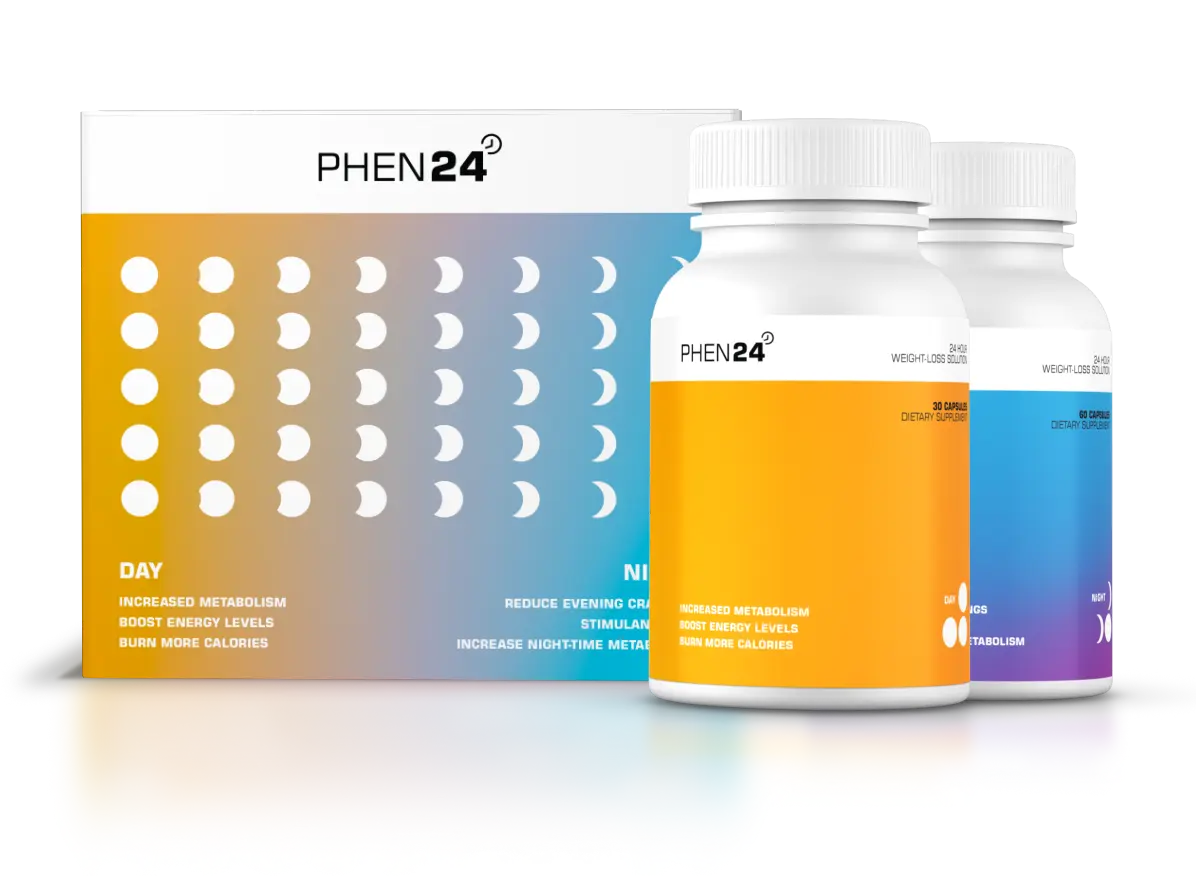
The Phen24 Day Formula focuses on three things: boosting your metabolism, increasing your energy so you can train hard despite eating less, and raising your body’s core temperature slightly to increase calorie burn throughout the day.
The key ingredients doing the heavy lifting here are caffeine and guarana extract.
Caffeine delivers an immediate, clean energy lift that blunts fatigue and increases thermogenesis.
Guarana’s energy release is slower and more sustained, which smooths out the crash that sometimes follows straight caffeine and keeps focus stable for longer.
Cayenne powder rounds out the thermogenic side — capsaicin (the active compound in cayenne) has meaningful clinical evidence for raising metabolic rate and increasing fat oxidation.
Zinc and manganese are also included in the day formula.
Zinc is worth paying attention to because testosterone levels — which are important for both fat metabolism and muscle preservation — tend to drop during extended caloric restriction, and zinc supports healthy testosterone production.
Manganese plays a role in energy metabolism and cognitive function, which helps with the mental clarity that tends to suffer when you’re eating less than usual.
The Phen24 Night Formula is where the product really separates itself from the competition.
While most fat burners are simply stimulant pills that stop being relevant after lunch, Phen24’s night formula actively works while you sleep.
It contains glucomannan — a soluble fiber that expands in the stomach and has strong clinical evidence for reducing appetite and curbing the late-night cravings that sabotage so many fat loss efforts.
Green tea extract appears in the night formula for its fat-oxidizing properties without the stimulant effect.
Vitamin C, choline, and a range of B vitamins support metabolic health, cortisol regulation, and the hormonal environment for fat burning while you rest.
The entire formula is made from natural ingredients.
There are no harsh synthetic compounds, no proprietary blends hiding underdosed ingredients, and no banned substances — which matters particularly for anyone competing in tested events.
Phen24 is manufactured by Wolfson Brands, the same company behind PhenQ and several other well-regarded natural supplements.
The practical way to use Phen24 is simple: two capsules with breakfast alongside your regular morning routine, and four night capsules with water around 15 minutes before your evening meal.
It integrates into your existing routine without any complicated protocol.
Think of it as the supplement layer that sits on top of your already-dialed-in diet and training — not a replacement for either, but a genuine enhancer that helps the process work better, faster, and with less friction.
Common Fat Loss Mistakes and How to Avoid Them
Even people who understand the basics of fat loss often make the same handful of mistakes that slow their progress or stop it entirely.
Knowing what they are in advance can save you weeks of frustration.
Mistake one: cutting calories too aggressively.
We covered this earlier, but it bears repeating because it’s the single most common error.
The urge to speed things up by eating dramatically less is understandable.
But the outcome is almost always the same — rapid initial weight loss followed by a plateau, muscle loss, and a metabolism that’s now running slower than it was before the diet.
A deficit of 300–500 calories is boring but it works.
Stick with it.
Mistake two: doing too much cardio and not enough weights.
Running every day while lifting nothing creates a body that’s smaller but still lacks definition and carries a frustratingly high body fat percentage relative to what you’d expect.
Muscle mass drives metabolism.
Cardio burns calories in the moment but does very little to change your baseline metabolic rate.
Prioritize the iron.
Mistake three: treating sleep as optional.
As we’ve already covered, poor sleep raises cortisol, disrupts hunger hormones, and actively makes fat loss harder.
You cannot out-train or out-diet a chronically sleep-deprived body.
Seven hours minimum.
Eight is better.
Mistake four: trusting the scale too much.
Body weight can fluctuate by three to five pounds day-to-day based purely on water retention, digestive contents, and hormonal cycles.
Weighing yourself once a day and reading too much into the number is a recipe for anxiety and inconsistency.
Weigh yourself every morning under the same conditions (after waking, before eating, after using the bathroom) and track the weekly average instead.
Progress photos taken under the same lighting once a week are equally valuable.
Mistake five: expecting results too quickly.
This might be the deepest mistake of all.
Sustainable fat loss takes time — real time.
If you’re losing half a pound to a pound per week, you’re doing great.
Don’t let slow weeks on the scale convince you that nothing is working.
Zooming out to see the month-by-month trend is where the real progress becomes visible.
Stay consistent.
The results always show up — just rarely on the schedule we wish they would.
The Bottom Line
Learning how to cut body fat effectively isn’t about finding a secret hack or the most extreme protocol on the internet.
It’s about stacking smart, proven habits — a moderate caloric deficit, high protein, consistent strength training, strategic cardio, quality sleep — and doing them consistently enough for the results to compound.
The process is simple.
Not always easy.
But simple.
And the people who succeed long-term aren’t always the ones with the best genetics or the most expensive gym memberships.
They’re the ones who stay consistent week after week, even when progress feels invisible.
Start with one or two things from this guide this week.
Master them.
Then add more.
And if you want an extra edge — something to help keep your metabolism elevated, your cravings manageable, and your fat-burning running 24 hours a day — a well-formulated natural supplement like Phen24 is worth adding to your stack.
You’ve got everything you need.
Now go make it happen.
Disclaimer: Always consult a qualified healthcare professional before starting any new diet, exercise program, or supplement regimen, particularly if you have pre-existing medical conditions.