
DIM and the Testosterone-to-Estrogen Ratio in Men: What the Research Actually Shows
Does DIM improve the testosterone-to-estrogen ratio in men? Nobody knows, and that’s the honest answer. No published randomized trial has ever measured DIM’s effect on the T:E ratio in healthy men.
What DIM does do is well established: it shifts estrogen breakdown toward the weaker 2-hydroxyestrone pathway. That is a change in metabolism, not proof that your estradiol falls or your testosterone rises.
The one controlled trial that measured SHBG found it went up on DIM, which can pull free testosterone down rather than up. If you try DIM, treat it as an experiment you verify with blood work — baseline labs, a moderate dose, and a sensitive estradiol test on both ends.
Your testosterone number only tells part of the story. Estradiol, the main estrogen in men, is made largely from testosterone itself.
So the two hormones are linked far more tightly than most guys realize. That is why the testosterone-to-estrogen (T:E) ratio gets so much attention in gyms and on TRT forums.
It is also why DIM keeps popping up as the “natural fix.” It comes from broccoli, it is cheap, and the marketing around it is loud.
This guide cuts through that. Where the research is solid, we say so, and where it is thin or comes mostly from women, we say that too.
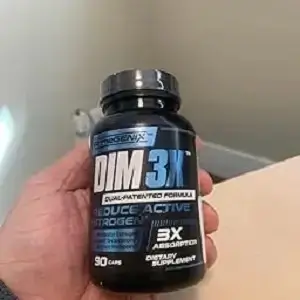
Our pick is PrimeGENIX DIM 3X — 200 mg of DIM, dose disclosed, absorption support, COA published. Read the research first, though: it changes what you should expect from it.
What the Testosterone-to-Estrogen Ratio Really Means
An enzyme called aromatase converts some of your testosterone into estradiol. Every man's estrogen level is therefore partly a reflection of his testosterone level.
The T:E ratio divides one by the other. It is a quick way to see whether estradiol is running high or low compared with the testosterone that feeds it.
Men actually need estradiol
Estradiol is not a contaminant in the male body. It helps protect bone, supports libido and erections, and influences where you store fat.
The clearest evidence comes from a 2013 study in the New England Journal of Medicine involving 400 healthy men aged 20 to 50. Researchers used goserelin to shut down the men's own production, then gave graded testosterone doses with or without anastrozole to block conversion to estradiol.
When estradiol was blocked, body fat rose. Low estrogen also contributed to the decline in sexual function — the exact outcome most men taking an "estrogen blocker" are trying to avoid.
So lower estrogen is not automatically better. The aim is a level that suits your testosterone, not the smallest number on the report.
Watch the units before you trust a ratio
The popular "10:1" rule causes endless confusion because the two hormones are reported in different units. In the US, testosterone is usually given in ng/dL and estradiol in pg/mL.
Take a man with testosterone at 600 ng/dL and estradiol at 25 pg/mL. Divide the raw numbers and you get 24. Convert both to pmol/L and the ratio is closer to 227.
Same man, same blood draw, three wildly different "ratios" depending on which units you used. Any forum target number is meaningless unless the units come with it.
The Endocrine Society's testosterone guideline does not set any target T:E ratio. Use your own ratio as a personal benchmark to track over time, not as a diagnosis.
Total testosterone, free testosterone and SHBG
Most testosterone in your blood is bound to a protein called sex hormone-binding globulin (SHBG). Only a small unbound fraction is "free" and able to act directly on muscle, brain and other tissue.
This matters a lot for DIM. Anything that raises SHBG can lower free testosterone, even if your total testosterone stays the same.
Ask for the right estradiol test
Standard estradiol tests were built for women, whose levels are far higher. At the low concentrations typical in men, many of these tests are unreliable.
A CDC-led comparison found high variability in estradiol results, especially at low concentrations. Another study in men found immunoassay readings may be skewed by interference linked to inflammation.
If you want numbers you can act on, ask for a sensitive or "ultrasensitive" estradiol test run by LC-MS/MS. Most labs will do it if you specify it.
Without it, your T:E ratio is built on a shaky number — and you will end up adjusting a supplement in response to assay noise.
What Pushes the Ratio Out of Balance
The ratio rarely drifts for no reason. A handful of causes explain most cases, and body fat sits at the top of the list.
Excess body fat
Fat tissue contains aromatase, and a 2022 review notes that fat from obese men shows higher aromatase activity. Low testosterone also encourages more fat gain, so the two problems feed each other.
The story is less simple than supplement ads suggest, though. A review of obesity and male hypogonadism points out that large LC-MS/MS studies found lower estradiol in men with low testosterone, with clearly raised estradiol seen mainly in extreme obesity.
In plain terms, many overweight men with low testosterone do not have "high estrogen." They have low testosterone.
Taking an estrogen-lowering supplement for that is treating a problem you don't have. Fixing it usually starts with losing fat.
Getting older
Testosterone tends to drift down with age while fat mass tends to creep up. Both changes can shift the ratio, though how much varies hugely from one man to the next.
Low zinc, poor sleep and heavy drinking
Nutrient gaps and lifestyle habits can drag testosterone down. In a small study on zinc, restricting dietary zinc for 20 weeks lowered testosterone substantially in young men, while supplementing zinc-deficient older men raised it.
That was a small sample, so treat it as suggestive rather than settled. The useful read is that correcting a genuine deficiency helps, not that extra zinc on top of an adequate intake does anything.
Regular short sleep and heavy alcohol use are also well-known testosterone drains. Neither one is fixed by a capsule.
TRT, steroids and some medications
More testosterone in the system means more raw material for aromatase. That is why men on TRT or anabolic steroids often see estradiol climb.
If that describes you, estrogen management belongs with your prescriber. It is not a job to hand over to a supplement on your own.
What DIM Is and How It Works
DIM (3,3'-diindolylmethane) forms in your stomach after you eat cruciferous vegetables such as broccoli, cabbage and Brussels sprouts. A plant compound called indole-3-carbinol breaks down in stomach acid and pairs up to create it.
A supplement gives you far more DIM than any normal diet would. That is the appeal, and it is also why the safety questions below matter.
The estrogen metabolism shift
Your body breaks estrogen down along several routes. Two of the main products are 2-hydroxyestrone (2-OHE1), a weaker metabolite, and 16α-hydroxyestrone (16α-OHE1), a more active one.
DIM pushes metabolism toward the 2-OHE1 route, which raises what researchers call the 2:16 ratio. This shift has shown up consistently in human studies, including a 12-month randomized trial and a thyroid pilot study.
What that shift does not prove
A better 2:16 ratio means your body is breaking estrogen down differently. It does not necessarily mean your blood estradiol falls, and it tells you very little about testosterone.
That gap between "changes estrogen metabolites" and "improves your T:E ratio" is where most DIM marketing quietly overreaches.
The SHBG catch
You will often read that DIM frees up testosterone by lowering SHBG. The best controlled data point the other way.
In a randomized, placebo-controlled trial, women taking 300 mg of DIM a day saw SHBG rise by about 25 nmol/L, compared with about 1 nmol/L on placebo. A 2020 systematic review of 22 human trials also lists increased SHBG among DIM's documented effects.
These were women, and men may respond differently. Still, higher SHBG binds more testosterone, so check your free testosterone rather than assume it went up.
DIM also has anti-androgen effects
This is the part most DIM articles leave out. In prostate cancer research, DIM is described as an anti-androgen that down-regulates the androgen receptor.
That is helpful when you are fighting prostate cancer cells. It is not what a lifter wants happening in his muscles.
In a rat study, higher DIM doses harmed sperm quality and damaged testicular tissue in a dose-dependent way. Rat data do not translate neatly to people, but they are a good reason to treat "more is better" with suspicion.
What the Research Actually Shows
Human research on DIM is real, but it is narrow. Most studies involved women or patients with cancer or thyroid disease, and they measured estrogen metabolites rather than how men look, feel or perform.
| Study | Who was studied | Dose and length | Main finding | What it means for healthy men |
|---|---|---|---|---|
| Randomized trial, 2017 | 130 women taking tamoxifen | 150 mg twice daily, 12 months | Higher 2:16 ratio, SHBG up about 25 nmol/L, lower tamoxifen metabolites | Indirect, but the best data we have on SHBG |
| Pilot study, 2011 | Patients with thyroid proliferative disease | 300 mg a day, 14 days | Higher 2:16 ratio, DIM detected in thyroid tissue | Confirms the metabolic shift happens in people |
| Phase I trial | Men with castrate-resistant prostate cancer | 75 to 300 mg twice daily | Well tolerated, described as anti-androgenic | Men — but not healthy men, and anti-androgenic is the wrong direction |
| Rat study, 2016 | Male rats | 10 to 100 mg/kg, 53 days | Dose-dependent harm to sperm quality and testicular tissue | Animal data only, but a reason to avoid megadosing |
| Systematic review, 2020 | 22 human trials | Various | Shifts estrogen metabolism and raises SHBG; no proof it treats cancer | Sums up the whole field as it stands |
What is still missing
We could not find a published randomized trial testing DIM on the T:E ratio, free testosterone, body fat or libido in healthy men. Until one exists, any promise of guaranteed results is marketing, not science.
That does not make DIM useless. It just means the honest way to use it is as a personal experiment that you measure with blood work.
How to Use DIM Sensibly
If you decide to try DIM, run it like an experiment. You want a clear before, a clear after, and the willingness to stop if the numbers move the wrong way.
- Get baseline blood work. Test total testosterone, free testosterone, SHBG and a sensitive (LC-MS/MS) estradiol, taken in the morning while fasted.
- Start with a moderate dose. Human studies have mostly used 100 to 300 mg a day, and around 200 mg is a sensible middle ground for most men.
- Take it with a meal. DIM is fat-soluble and poorly absorbed on its own, so a meal containing some fat — and a formula with an absorption enhancer — both help.
- Give it time. Stick with it consistently for 8 to 12 weeks before judging anything.
- Retest the same way. Same lab, same time of day, same panel, so you are comparing like with like.
How to read your results
Look at the whole panel, not just estradiol. The most useful number for how you actually feel is often free testosterone.
If SHBG went up and free testosterone went down, DIM may be working against you. Lower the dose or stop, and talk it through with your doctor.
The Endocrine Society also recommends confirming low testosterone with a repeat morning test. One result on one day is not a trend.
If you are on TRT
Do not use DIM as a do-it-yourself replacement for your clinician's estrogen plan. Changes in SHBG and estradiol can affect how your dose should be adjusted.
Tell your prescriber before you add it. They may be glad you asked, and your labs will make more sense to both of you.
Side Effects and Who Should Avoid DIM
Most men tolerate typical doses without trouble. In the phase I prostate cancer trial, DIM was well tolerated across the doses tested.
Users commonly report darker urine, mild headaches or an upset stomach in the first couple of weeks. These usually settle, but stop if they don't.
Talk to your doctor first, or skip DIM entirely, if you:
- Take tamoxifen or other hormone therapy. DIM lowered tamoxifen's active metabolites in the 2017 trial, which could weaken the drug.
- Are trying to conceive. The rat data on sperm quality are not proof of harm in men, but they are a reason to wait.
- Have prostate cancer or take androgen-blocking drugs. Use DIM only under your oncologist's guidance.
- Take prescription medicines processed by the liver. DIM affects liver enzymes that also clear many drugs.
- Compete in drug-tested sport. WADA's Prohibited List bans aromatase inhibitors and "other anti-estrogenic substances" under section S4.
DIM is not named on that list. However, because it is marketed as anti-estrogenic and supplements can be contaminated, tested athletes should check with their federation first.
Stop DIM and retest if you notice:
- Aching joints, particularly in the knees, wrists and elbows
- A sudden drop in libido, or erections that get noticeably worse
- Flat, low or irritable mood that doesn't track with anything else in your life
- Night sweats or poor sleep that started around the same time
The Finkelstein trial is the useful reminder here. Driving estrogen too low hurt body composition and sexual function — the opposite of what most men are after.
DIM vs Other Ways to Improve the Ratio
DIM is one tool among several, and it is not the strongest. Here is how the main options compare.
| Approach | What it does | Evidence in men |
|---|---|---|
| Losing excess body fat | Shrinks aromatase-rich tissue and breaks the fat / low-testosterone loop | Strongest |
| Strength training and adequate sleep | Supports healthy endogenous testosterone production | Good |
| Zinc, if you are deficient | Can raise testosterone in men who are genuinely low in zinc | Only when deficient |
| Prescription aromatase inhibitor | Blocks estrogen production directly | Strong, doctor-only |
| DIM | Shifts how existing estrogen is broken down | Indirect |
| Calcium D-glucarate | May support estrogen clearance through the liver | Very limited |
Start with the foundation
If you carry a lot of extra fat, losing it will almost certainly do more for your hormones than any supplement. Lift heavy, sleep seven to nine hours, and keep alcohol modest.
DIM can sit on top of that foundation. It cannot replace it.
Choosing a DIM Supplement: Our Pick Is PrimeGENIX DIM 3X
If you have done the groundwork and want to try DIM, product choice matters. Many DIM products hide the dose inside a proprietary blend or skip absorption support altogether.
Here is what we look for:
- A clearly stated DIM dose within the range used in human studies
- An absorption enhancer, since plain DIM is poorly absorbed
- Third-party testing with certificates of analysis you can actually read
- Manufacturing in a cGMP-certified facility
- DIM per serving 200 mg (1 capsule daily)
- Absorption AstraGin + BioPerine
- Also contains Vitamin E (134% DV)
- Testing Published certificate of analysis
- Made in cGMP-certified US facility
- Guarantee 67 days
- Price $59 single bottle; $49/bottle on multi-packs or subscription
That 200 mg sits squarely inside the 100–300 mg range used in human research, with no megadosing and no blend hiding the number.
What works
- Dose disclosed and research-aligned
- Two branded absorption enhancers, which matters for a fat-soluble compound
- COA published rather than promised
- 67 days is long enough to run a full lab-tested trial
What doesn't
- The finished formula has no clinical trial of its own
- Marketing claims aromatase blocking and testosterone support — neither confirmed for DIM in healthy men
- No sport certification listed, so tested athletes need to clear it first
- Single bottles are pricey unless you commit to a multi-pack
Full ingredient breakdown, pricing and the 67-day guarantee terms
What to keep in mind
DIM 3X as a finished formula has not been tested in its own published clinical trial. That is normal for supplements, but it means your blood work is the real test.
The brand's page also says it blocks aromatase and supports testosterone. Those effects have not been confirmed for DIM in healthy men, so judge it by your own labs rather than the label.
If you compete in tested sport, check for a sport certification and clear it with your federation first.
Frequently Asked Questions
Does DIM lower estradiol on a blood test?
Not reliably. DIM mainly changes how estrogen is broken down, so your serum estradiol may barely move even when your 2:16 ratio improves.
Does DIM raise testosterone?
There is no good evidence that it raises testosterone in healthy men. In the largest controlled trial it raised SHBG, which could actually lower free testosterone.
How long does DIM take to work?
Changes in estrogen metabolites showed up within 14 days in one pilot study. For anything you would notice, or see on a full hormone panel, give it 8 to 12 weeks and then retest.
Is DIM the same as anastrozole?
No. Anastrozole is a prescription drug that blocks estrogen production outright, while DIM changes how existing estrogen is metabolized.
That makes DIM milder, but it also means you cannot expect drug-like effects from it.
Can I take DIM while on TRT?
Some men do, but only with your prescriber's knowledge. DIM can change SHBG and estrogen readings, which affects how your dose should be managed.
Can I just eat more broccoli instead?
Eating more cruciferous vegetables is a great habit, and it does give you some DIM. You would need to eat a lot of them to match a supplement dose, though.
Is a 10:1 testosterone-to-estrogen ratio the target?
No. That number only works in one specific unit combination, and the Endocrine Society sets no target ratio at all.
Track your own ratio over time in consistent units instead of chasing a figure from a forum.
The Bottom Line
Your T:E ratio is worth knowing, but only if it is measured properly. That means morning labs, free testosterone, SHBG and a sensitive estradiol test.
DIM clearly changes how your body breaks estrogen down. Whether that improves the ratio in healthy men has not yet been tested, and its effects on SHBG and androgen receptors call for some caution.
If you want to try it, keep the dose moderate and choose a well-made product like PrimeGENIX DIM 3X. Then let your blood work, not the label, decide whether it stays in your routine.
And don't skip the basics. Losing excess fat, lifting, sleeping well and drinking less will move your hormones further than any capsule.
- Finkelstein JS, et al. Gonadal steroids and body composition, strength, and sexual function in men. N Engl J Med. 2013;369(11):1011–22. pubmed.ncbi.nlm.nih.gov/24024838
- Thomson CA, et al. A randomized, placebo-controlled trial of diindolylmethane for breast cancer biomarker modulation in patients taking tamoxifen. Breast Cancer Res Treat. 2017;165(1):97–107. pubmed.ncbi.nlm.nih.gov/28580520
- Rajoria S, et al. 3,3'-Diindolylmethane modulates estrogen metabolism in patients with thyroid proliferative disease: a pilot study. Thyroid. 2011;21(3):299–304. pubmed.ncbi.nlm.nih.gov/21254915
- Heath EI, et al. A phase I dose-escalation study of oral BR-DIM in castrate-resistant, non-metastatic prostate cancer. Am J Transl Res. pmc.ncbi.nlm.nih.gov/articles/PMC2923861
- 3,3'-Diindolylmethane leads to apoptosis, decreases sperm quality, affects blood estradiol 17β and testosterone in male rats. Andrologia. 2016;48(10):1155–65. pubmed.ncbi.nlm.nih.gov/26940815
- A systematic review of human clinical trials of 3,3'-diindolylmethane. Nutrition and Dietary Supplements. 2020. dovepress.com
- Bhasin S, et al. Testosterone therapy in men with hypogonadism: an Endocrine Society clinical practice guideline. J Clin Endocrinol Metab. 2018;103(5):1715–44. pubmed.ncbi.nlm.nih.gov/29562364
- High variability in serum estradiol measurements in men and women. pmc.ncbi.nlm.nih.gov/articles/PMC4306629
- Comparisons of immunoassay and mass spectrometry measurements of serum estradiol levels and their influence on clinical association studies in men. J Clin Endocrinol Metab. 2013. pubmed.ncbi.nlm.nih.gov/23589527
- Adipose tissue dysfunction and obesity-related male hypogonadism. Int J Mol Sci. 2022. pmc.ncbi.nlm.nih.gov/articles/PMC9369373
- Obesity and male hypogonadism: a review. pmc.ncbi.nlm.nih.gov/articles/PMC6305864
- Prasad AS, et al. Zinc status and serum testosterone levels of healthy adults. Nutrition. 1996;12(5):344–8. pubmed.ncbi.nlm.nih.gov/8875519
- World Anti-Doping Agency. The Prohibited List. wada-ama.org/en/prohibited-list
- PrimeGENIX. DIM 3X product page. Accessed October 15, 2026. primegenix.com/products/dim-3x