Caloric Deficit for Bodybuilding
Did you know that up to 50% of the weight lost during an aggressive cut can come from muscle — not fat? Let that sink in for a second. You spend months in the gym, grinding through heavy squats and deadlifts, eating chicken and rice until you can barely look at a meal prep container — and then you crash your calories and watch half your gains disappear. That’s not a cut. That’s sabotage.

Here’s the reality: most bodybuilders get the concept of a caloric deficit right but the execution completely wrong. They go too hard, too fast, and end up looking flat and depleted rather than lean and full. I’ve been there. Most serious lifters have. But once you understand how to structure a deficit properly — the right size, the right macros, the right training approach — everything changes.
A caloric deficit, when applied intelligently, is the most powerful tool you have for revealing the physique you’ve been building. It’s not about eating as little as possible. It’s about eating precisely — giving your body just enough of a reason to burn stored fat while holding onto every ounce of muscle you’ve earned. That balance is what this guide is all about.
Whether you’re eight weeks out from a competition, trying to drop a weight class, or just want to finally see your abs, the science-backed strategies in this article will give you a clear, actionable roadmap. No fad diets. No extreme protocols. Just proven principles that work.
What Is a Caloric Deficit and Why It Matters for Bodybuilders
At its most basic level, a caloric deficit simply means you’re consuming fewer calories than your body burns in a given day. Sounds straightforward, right? But for bodybuilders, it’s so much more nuanced than that — because the goal isn’t just to lose weight. It’s to lose fat specifically, while protecting the muscle tissue you’ve spent months or years building.
Your body is remarkably adaptive. When you eat less than you burn, it looks for alternative fuel sources. In an ideal scenario, it pulls from your stored body fat — those stubborn love handles, that layer over your abs. But here’s the uncomfortable truth: your body doesn’t automatically prioritize fat. Under the wrong conditions — too large a deficit, too little protein, too much stress — it will happily break down muscle tissue for energy instead. This process is called catabolism, and it’s every bodybuilder’s worst enemy during a cut.
This is where the bodybuilder’s challenge diverges sharply from the average person trying to lose weight. Someone who just wants to drop 20 pounds might not care whether they lose fat or muscle — the number on the scale is all that matters to them. But for a bodybuilder, body composition is everything. Dropping from 200lbs to 185lbs means nothing if you’ve lost 10lbs of muscle in the process. The physique you reveal at the end of a cut is only as impressive as the muscle you managed to preserve.
Understanding energy balance is the foundation of all of this. Your Total Daily Energy Expenditure (TDEE) is the total number of calories your body burns in a day, accounting for your Basal Metabolic Rate (BMR) — the calories burned just to keep you alive — plus all the energy you expend through exercise, digestion, and daily movement. Your deficit needs to be calculated against this number, not some generic 2,000-calorie guideline that has nothing to do with your body or training volume.
The size of your deficit is just as important as the deficit itself. A small deficit — say, 200 calories below TDEE — will produce very slow fat loss but excellent muscle retention. A large deficit — 1,000 calories or more — will produce faster weight loss on the scale, but a significant portion of that will be muscle, glycogen, and water. For most bodybuilders, the sweet spot lives somewhere in the middle, and finding it requires knowing your numbers.
How to Calculate Your Caloric Deficit for Bodybuilding
Before you can create an effective deficit, you need to know your starting point — and that means actually doing the math. Too many people just guess at their calories, eat “clean,” and hope for the best. That might work for a beginner, but if you’re serious about bodybuilding, precision is everything.
Step 1 — Calculate Your BMR
Your Basal Metabolic Rate is the number of calories your body needs to perform basic functions — breathing, circulation, cell repair — if you did absolutely nothing all day. The most accurate formula for most people is the Mifflin-St Jeor equation:
For men: (10 x weight in kg) + (6.25 x height in cm) – (5 x age) + 5
For women: (10 x weight in kg) + (6.25 x height in cm) – (5 x age) – 161
This gives you a baseline, but it’s only the starting point.
Step 2 — Find Your TDEE
Multiply your BMR by an activity factor to get your Total Daily Energy Expenditure. A commonly used scale runs from 1.2 (sedentary) to 1.9 (extremely active). For most bodybuilders training 4–5 days per week with moderate to high intensity, a multiplier of 1.55 to 1.725 is typically appropriate. This figure represents roughly how many calories you need to maintain your current weight — your maintenance calories.
Step 3 — Apply Your Deficit
For bodybuilders, a deficit of 300–500 calories below TDEE is the gold standard. This range allows for steady fat loss of approximately 0.5–1lb per week while minimizing muscle loss. It’s not glamorous. It’s not fast. But it’s the approach that produces the best body composition results over time.
Aggressive deficits of 750–1,000+ calories might look appealing when you’re 12 weeks out and panicking, but they consistently backfire. They tank your energy, crush your performance in the gym, suppress testosterone, and trigger metabolic adaptation — where your body literally slows down its calorie burning in response to the restriction. You end up spinning your wheels, burning muscle, and feeling awful.
A smarter approach for those who need faster results is the “mini cut” strategy — a short, focused deficit phase of 4–8 weeks with a slightly more aggressive deficit (500–600 calories), followed by a maintenance or surplus phase. This prevents prolonged metabolic adaptation while still producing meaningful fat loss.
Once your deficit is set, track your actual intake using an app like MyFitnessPal, Cronometer, or MacroFactor. Weigh your food, at least initially. Most people dramatically underestimate portion sizes, and even 200–300 unreported calories daily can completely stall progress. As your body weight drops, recalculate your TDEE every 2–4 weeks and adjust accordingly.
Optimal Macros While in a Caloric Deficit for Bodybuilding
Calories are the big lever, but macronutrients are where bodybuilding nutrition gets really interesting. Two people can eat the same number of calories and have completely different results depending on how those calories are distributed across protein, carbohydrates, and fat. Getting your macros right during a cut is what separates someone who loses fat and keeps their muscle from someone who just looks smaller.
Protein — Your Most Important Macro
If there’s one thing you take from this entire guide, let it be this: eat enough protein. During a caloric deficit, muscle tissue is under threat. Protein is the primary defense. Aim for 0.8–1.2 grams of protein per pound of bodyweight daily — leaner individuals and those in larger deficits should sit toward the higher end of that range. So if you weigh 190lbs, you’re targeting somewhere between 152g and 228g of protein per day.
The evidence behind high-protein diets during a cut is overwhelming. Not only does protein provide the amino acids needed for muscle repair and synthesis, but it also has the highest thermic effect of any macronutrient — meaning your body burns more calories just digesting it. It also has a powerful satiating effect, helping to manage hunger during a period when you’re eating less than you’d like.
Carbohydrates — Fuel, Not the Enemy
Carbs have been unfairly demonized in the fitness world for decades. The truth is, carbohydrates are your primary training fuel, and slashing them too aggressively will directly impair your performance in the gym — which is the last thing you want when you’re trying to maintain strength and muscle volume during a cut. Rather than eliminating carbs, strategically time them around your training. Consume the majority of your carbohydrate intake in the pre- and post-workout window to fuel performance and support glycogen replenishment.
Fats — Non-Negotiable for Hormonal Health
This is where a lot of bodybuilders make a critical mistake — they slash dietary fat to almost nothing in an attempt to reduce calories. But fat is essential for hormone production, including testosterone. Drop fat intake too low — below roughly 0.3g per pound of bodyweight — and you’ll start to see measurable drops in testosterone levels. Testosterone is your greatest ally for muscle retention. Protect it.
Healthy fat sources like avocado, olive oil, eggs, fatty fish, and nuts should remain a consistent part of your cutting diet. Aim for fat to make up roughly 20–25% of your total calorie intake.
Sample Macro Split
For a 185lb bodybuilder eating 2,400 calories in a deficit, a solid starting point looks like this:
- Protein: 200g (800 calories — 33%)
- Carbohydrates: 240g (960 calories — 40%)
- Fat: 71g (640 calories — 27%)
This is a starting point, not a rigid formula. Adjust based on your training schedule, hunger levels, and how your body responds over time.
How to Preserve Muscle Mass During a Caloric Deficit
Muscle preservation during a cut isn’t just about what you eat — it’s about the total picture of how you train, recover, and live. Every variable matters.
Keep Lifting Heavy
This is probably the most counterintuitive thing about cutting for bodybuilders who are new to the process. When you’re eating less and your energy is lower, the natural instinct is to back off the weights and do more cardio. Resist that urge completely. Your muscles need a reason to exist. If you stop providing the mechanical stimulus that built them in the first place, your body has no reason to keep them around when calories are scarce.
Focus on maintaining your progressive overload. You may not be setting new PRs during a cut, and that’s fine. The goal is to maintain your strength as closely as possible. If your bench press stays close to your pre-cut numbers, you’re almost certainly retaining the muscle behind it.
Protein Timing Matters
Spreading your protein intake across 4–5 meals throughout the day is more effective for muscle protein synthesis than eating the same total amount in 1–2 large meals. Each meal should ideally contain at least 30–40g of protein to cross the leucine threshold — the minimum amino acid trigger required to initiate a meaningful muscle-building response. Think of it as pressing the “muscle maintenance” button multiple times throughout the day rather than once.
Sleep Is Non-Negotiable
Sleep deprivation is one of the fastest ways to destroy a cut. Studies consistently show that inadequate sleep — less than 7 hours — dramatically increases cortisol levels, suppresses anabolic hormones like testosterone and IGF-1, increases hunger through elevated ghrelin, and shifts the body into a more catabolic state. In one landmark study, subjects in a caloric deficit who slept 5.5 hours lost significantly more muscle mass than those who slept 8.5 hours — despite eating the exact same diet. What happens outside the gym is just as important as what happens inside it.
Strategic Cardio
Cardio is a useful tool during a cut, but it’s easy to overdo. Excess cardio creates additional recovery demands, increases cortisol, and can interfere with strength training adaptations. Low-Intensity Steady-State (LISS) cardio — walking, cycling, swimming at a moderate pace — is generally preferable during a bodybuilding cut because it burns calories without significantly impacting muscle recovery. Keep sessions to 20–40 minutes, 3–4 times per week, and treat cardio as a supplement to your deficit, not the foundation of it.
Evidence-Based Fat-Burning Strategies to Maximize Your Cut
Beyond the basics of deficit and macros, there are several additional strategies that can meaningfully accelerate fat loss while protecting your physique. These aren’t hacks or shortcuts — they’re evidence-backed principles that work synergistically with your nutrition and training.
Prioritize Whole, Satiating Foods
One of the most underrated aspects of a successful cut is managing hunger. A 500-calorie deficit feels completely different depending on what those calories are made of. 500 calories of ultra-processed snacks will leave you starving an hour later. 500 calories worth of chicken breast, vegetables, and a sweet potato will keep you full for hours. Whole, high-volume, high-fiber foods are your best friends during a cut — leafy greens, cruciferous vegetables, legumes, oats, and lean proteins.
The Thermic Effect of Food
Protein doesn’t just build muscle — it burns more calories during digestion than carbohydrates or fat. This is known as the thermic effect of food (TEF). Protein has a TEF of roughly 20–30%, meaning that for every 100 calories of protein you eat, your body burns 20–30 calories just breaking it down. Keeping protein high during a cut essentially gives you a small metabolic bonus on top of your deficit.
NEAT — The Underrated Fat Loss Variable
Non-Exercise Activity Thermogenesis (NEAT) refers to all the calories you burn through movement that isn’t formal exercise — walking to the coffee shop, fidgeting, taking the stairs, pacing while on a phone call. Research shows that NEAT can vary by up to 2,000 calories per day between individuals of similar size. During a caloric deficit, many people unconsciously reduce their NEAT — they sit more, move less — which significantly blunts fat loss. A step goal of 8,000–10,000 steps per day is a practical way to keep NEAT elevated during a cut.
Stress Management
Chronic stress is a silent killer of fat loss goals. When cortisol is chronically elevated — through work stress, overtraining, or poor sleep — it promotes fat storage (particularly visceral fat around the abdomen), increases appetite, impairs recovery, and suppresses testosterone. Finding ways to actively manage stress — meditation, time in nature, reducing training volume temporarily — isn’t soft. It’s smart physiology.
What the Research Actually Says About Supplements
The supplement industry will try to sell you a fat-burning miracle in every form imaginable. The reality is that the number of compounds with genuine evidence behind them is very small:
- Caffeine: One of the most well-researched ergogenic aids in existence. Caffeine increases metabolic rate, enhances fat oxidation, and improves training performance. 200–400mg pre-workout is effective for most people.
- Creatine monohydrate: Not a fat burner, but it helps maintain strength and muscle volume during a cut — exactly what you need.
- Whey protein: A convenient and practical way to hit your daily protein targets.
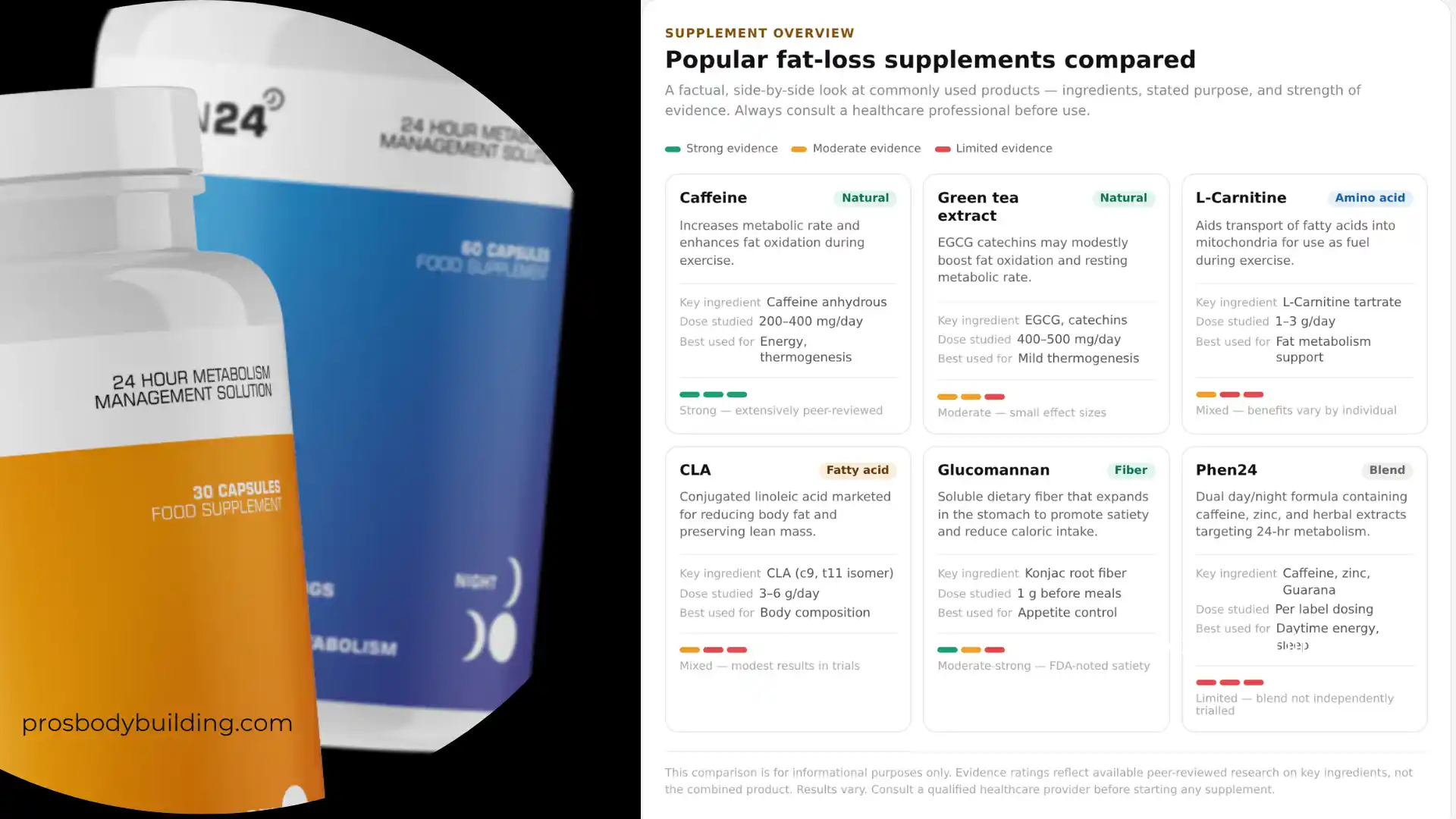
On the subject of popular over-the-counter products — one that frequently comes up in bodybuilding circles is Phen24, a dual-formula supplement marketed with separate day and night capsules, targeting daytime energy expenditure and nighttime metabolism. It contains ingredients like caffeine, zinc, and various herbal extracts.
While some individual ingredients have modest research behind them, it’s worth noting that Phen24 as a combined formulation has not been independently studied in peer-reviewed clinical trials. As with any supplement, individual results will vary considerably, and no product can replicate the foundation of a well-structured diet and training program. If you’re considering adding any supplement to your regimen, consult a healthcare professional first.
Click Here To Read My Unbiased Phen24 Review
Hydration
Staying well-hydrated during a cut is more important than most people realize. Even mild dehydration impairs gym performance, dulls cognitive function, and can be misread by the brain as hunger — leading to unnecessary snacking. Aim for at least 3–4 liters of water daily, more if you’re training hard or in a hot environment.
Common Caloric Deficit Mistakes Bodybuilders Make
Even experienced athletes make these mistakes. Knowing them in advance can save you weeks of stalled progress and real frustration.
Cutting Too Aggressively
The most common mistake, bar none. In an attempt to get lean fast, bodybuilders slash their calories by 1,000 or more below maintenance. The initial results look promising — the scale drops quickly. But within 2–3 weeks, the body adapts. Metabolic rate slows, thyroid output decreases, and muscle tissue starts breaking down as the body attempts to reduce its overall energy needs. What looked like a productive cut turns into a metabolic mess that takes months to fully reverse.
Not Tracking Accurately
Eyeballing portions is one of the biggest sources of error in any diet plan. Studies show that people consistently underestimate their calorie intake by 20–40% when not tracking meticulously. A tablespoon of peanut butter that you think is one serving might actually be two. That cooking oil you splashed in the pan? That’s 120 calories you didn’t log. Get a food scale, use it consistently, and you’ll quickly find where your hidden calories are hiding.
Too Much Cardio, Not Enough Iron
Swapping weight sessions for extra cardio during a cut is a common but costly mistake. Cardio burns calories — but it does nothing to preserve muscle mass. In fact, excessive endurance training combined with a caloric deficit actively signals the body to reduce muscle mass, since muscle is metabolically expensive tissue that endurance physiology doesn’t require. Keep resistance training as your primary modality. Use cardio as a supplementary tool, not a replacement.
Cutting for Too Long Without a Break
Prolonged caloric restriction leads to progressive metabolic adaptation, hormonal disruption, and psychological fatigue. Building in refeed days (one day per week at maintenance calories, primarily from carbohydrates) and full diet breaks (1–2 weeks at maintenance every 6–8 weeks) helps restore leptin levels, refill glycogen, improve performance, and give your mind a rest. These breaks don’t set back your progress — they protect it.
Ignoring Liquid Calories
Protein shakes, sports drinks, fruit juice, coffee with cream and sugar, alcohol — these calories count, and they add up faster than you’d think. A couple of glasses of wine on a Friday evening can easily represent 300+ unreported calories. Staying mindful of liquid intake is especially important during a cut when every calorie needs to be working for you.
How to Structure a Bodybuilding Cut: Week-by-Week Strategy
A successful cut isn’t something you wing — it’s something you plan. Here’s a practical framework for a 12-week cutting phase from start to finish.
Phase 1: Weeks 1–2 — Establish Your Baseline
Before you reduce anything, spend one to two weeks tracking your current food intake at maintenance to establish accurate data. Many people discover they’ve been eating significantly less — or more — than they thought. Use this period to dial in your food scale habits, identify hidden calories, and set your macros. Accurate data at the start produces far better outcomes than guessing.
Phase 2: Weeks 3–10 — The Active Cut
This is where the real work happens. Hit your macros consistently every day, monitor your weekly average weight (not daily fluctuations — water retention causes too much noise), and take weekly progress photos. Aim for 0.5–1% of bodyweight lost per week. If you’re losing faster, increase calories slightly. If the scale hasn’t moved in two weeks, reduce by 100–150 calories and reassess.
Build in one refeed day per week — a day where you bring calories up to maintenance, primarily through carbohydrates. This isn’t a cheat day. It’s a strategic tool to restore glycogen, briefly suppress cortisol, and keep your metabolism from fully adapting to the deficit.
Phase 3: Weeks 11–12 — Peak and Transition
For competitive bodybuilders, this is peak week — a period of careful water, sodium, and carbohydrate manipulation to maximize muscle fullness and definition on stage. The foundational principle is to arrive at this phase lean enough that the manipulation is subtle, not the entire strategy.
For non-competitors, this phase is about transitioning out of the cut intelligently. Begin reverse dieting — gradually increasing calories by 50–100 per week back toward maintenance. This prevents the rapid fat regain that comes from jumping straight from a large deficit back to full maintenance or surplus calories.
Caloric Deficit for Natural vs. Enhanced Bodybuilders
This is a conversation that doesn’t get enough honest airtime in the fitness industry. The physiological landscape for a natural bodybuilder during a cut is fundamentally different from that of someone using anabolic compounds — and the strategies that work for each group reflect those differences.
Natural bodybuilders operate without the muscle-sparing benefits that anabolic steroids and related compounds provide. Exogenous testosterone and other anabolic agents dramatically upregulate protein synthesis and inhibit muscle protein breakdown, even in a significant caloric deficit. This is why you can find enhanced bodybuilders losing 1–2lbs per week while maintaining or even gaining muscle — a physiological scenario that is largely impossible for a natural athlete at the same deficit.
For natural bodybuilders, the research is fairly clear: fat loss of more than roughly 0.5–1% of bodyweight per week significantly increases the risk of muscle loss. A 180lb natural bodybuilder should aim to lose no more than 0.9–1.8lbs per week during a cut. Going faster than this almost guarantees muscle loss alongside the fat.
This means natural athletes need to be more patient, more precise, and more protective of their recovery. Slower cuts, higher protein intakes, consistent sleep, and careful management of training volume are all more critical for the natural bodybuilder. The timeline to get from 15% body fat to competition-ready 5–6% might take 20–24 weeks for a natural — not the 12–16 that an enhanced athlete might achieve. That’s not a failure. That’s physiology.
Set realistic expectations. A natural bodybuilder who gets truly lean — single-digit body fat with visible muscle separation — has achieved something genuinely impressive. Don’t let unrealistic comparisons to enhanced athletes set standards your body isn’t equipped to meet in the same timeframe.
Conclusion
If you’ve made it this far, you now have more practical knowledge about caloric deficits for bodybuilding than the majority of people in any gym. But knowledge only matters if you act on it.
A caloric deficit — structured correctly — is how physiques are revealed. Not destroyed. The difference between a bodybuilder who finishes a cut looking hard, full, and muscular and one who looks flat and depleted comes down to exactly the principles we’ve covered: a moderate deficit calculated from your actual TDEE, high protein, strategic carbs and fats, heavy training maintained throughout, adequate sleep, managed stress, and patience.
There are no shortcuts here. There never were. But there is a clear, repeatable process — and now you have it. Calculate your numbers, set up your macros, track your intake honestly, and commit to the process for long enough to see it work.
Start today. Calculate your TDEE, set your 300–500 calorie deficit, hit your protein target, and log your first week. Your best physique isn’t waiting for a perfect moment — it’s waiting for you to get your nutrition dialed in and stay consistent long enough to earn it.