
DIM and Gynecomastia in Men: Can This Natural Compound Really Help Prevent and Reduce Male Breast Tissue?
Nobody wants to talk about it — but a staggering number of men are dealing with it.
Gynecomastia, the development of excess glandular breast tissue in men, affects an estimated 40 to 60 percent of males at some point in their lives.

That is not a fringe condition. That is nearly every other man walking into a gym, an office, or a doctor’s waiting room quietly wondering why their chest does not look the way it should.
The conversation around gynecomastia has historically been dominated by two camps: those recommending pharmaceutical estrogen blockers with significant side effect profiles, and those recommending surgery as the only definitive solution.
But in recent years, a third option has entered the discussion — and it comes from an unlikely source. Broccoli.
DIM, or Diindolylmethane, is a natural compound derived from cruciferous vegetables that has gained significant traction in men’s hormonal health circles for its ability to modulate estrogen metabolism.
The question on every man’s mind who has stumbled across DIM in relation to gynecomastia is simple: does it actually work?
And equally important — what kind of gynecomastia can it help with, what can it not touch, and how do you use it correctly if it is appropriate for your situation?
This guide answers all of those questions with the clarity and honesty that most supplement articles never bother to provide. No overselling. No false hope. Just the science, the practical protocol, and the frank assessment of what DIM can and cannot realistically achieve.
What Is Gynecomastia and Why Does It Happen in Men?
Before we can assess whether DIM has any role in managing gynecomastia, we need to be precise about what gynecomastia actually is.
Because the word is used loosely — and the distinction between true gynecomastia and its lookalike determines everything about whether DIM is relevant to your situation.
True Gynecomastia vs Pseudogynecomastia
True gynecomastia is the development of actual glandular breast tissue beneath the nipple — tissue that responds to estrogen signaling, has a firm or rubbery texture, and cannot be eliminated through diet or exercise alone.
Pseudogynecomastia, by contrast, is simply fat accumulation in the chest area — it looks similar but has no glandular component, and it does respond to caloric deficit and training.
This distinction is critical because DIM operates on the hormonal pathways that drive glandular proliferation — it has no mechanism of action that affects adipose tissue in the chest.
If you have pseudogynecomastia, the answer is fat loss — not DIM. If you have true gynecomastia, DIM enters the conversation.
How Estrogen Drives Gynecomastia
Male breast tissue contains estrogen receptors — and when estrogen activity exceeds a threshold relative to testosterone, these receptors can be stimulated into producing glandular tissue.
The primary driver is aromatization — the enzymatic conversion of testosterone to estradiol through the aromatase enzyme, which is present in significant quantities in adipose tissue.
The result is a testosterone-to-estrogen ratio that has shifted sufficiently in estrogen’s favor to trigger glandular development — and once that tissue forms and matures, it behaves differently depending on how long it has been present.
The Stages of Gynecomastia
Early-stage gynecomastia — weeks to a few months old — presents as breast tenderness, nipple sensitivity, and a soft, mobile subareolar mass.
This stage is actively hormonally driven and is the window where hormonal interventions, including DIM, have the greatest potential relevance.
Established gynecomastia — present for more than 12 to 18 months — has typically undergone fibrotic changes, becoming denser, firmer, and no longer directly responsive to hormonal manipulation.
At this stage, the glandular tissue has essentially become scar-like — and no supplement, including DIM, can reverse fibrotic tissue. Surgery is the only effective option at that point.
Common Causes in Men
Puberty is the most common cause of gynecomastia overall, accounting for the majority of adolescent cases that typically resolve spontaneously.
In adult men, the most relevant causes are obesity (increased aromatase activity in adipose tissue), anabolic steroid use, testosterone replacement therapy, certain medications (particularly antipsychotics, antifungals, and some antihypertensives), and liver disease.
Gynecomastia in Men by Age Group
Estimated gynecomastia prevalence by male age group
Estimated prevalence based on published clinical literature. Values represent midpoints of reported ranges. Individual risk varies based on hormonal status, body composition, and medications.
How DIM Works as a Natural Estrogen Modulator
DIM is not an estrogen blocker. This is the most important thing to understand about it before assessing its relevance to gynecomastia.
It is an estrogen metabolic modulator — and the distinction between blocking and modulating is exactly why DIM has the profile it does.
The Indole-3-Carbinol Connection
DIM forms in your body when you eat cruciferous vegetables — broccoli, cauliflower, kale, cabbage — through the stomach-acid-driven breakdown of a compound called indole-3-carbinol.
Supplemental DIM delivers this compound directly, bypassing the need for the dietary precursor and providing consistent, measurable doses that food sources cannot reliably deliver.
The Estrogen Metabolite Pathway
When estrogen is metabolized in the body, it is directed down one of two primary pathways.
The 2-hydroxyestrone pathway produces metabolites that have significantly reduced estrogenic activity — they do not strongly bind to estrogen receptors and do not drive the tissue proliferation associated with gynecomastia.
The 16-alpha-hydroxyestrone pathway produces more potent estrogen metabolites that maintain strong estrogenic activity — capable of binding estrogen receptors in breast tissue and stimulating glandular development.
DIM actively promotes the 2-hydroxy pathway and suppresses the 16-alpha pathway — essentially improving the quality of estrogen metabolism rather than eliminating estrogen entirely.
Why This Matters for Gynecomastia
If the 16-alpha estrogen metabolites are the primary drivers of estrogen receptor stimulation in breast tissue, then redirecting estrogen metabolism away from that pathway reduces the estrogenic signal that breast tissue is receiving.
This is not the same as eliminating estrogen — it is making the estrogen that remains less capable of driving glandular proliferation.
For early-stage gynecomastia where glandular tissue is actively responding to estrogenic stimulation, this metabolic redirection represents a genuinely meaningful mechanism of action.
The SHBG Effect
DIM also appears to modestly influence sex hormone binding globulin, potentially reducing the binding of testosterone and increasing free testosterone availability.
This shift in the testosterone-to-estrogen effective ratio adds a secondary mechanism through which DIM may support a hormonal environment less conducive to breast tissue stimulation.
The Science Behind DIM and Gynecomastia — What the Research Actually Shows
Let us be honest about the research situation before going further.
There are no large-scale randomized controlled trials specifically examining DIM supplementation for gynecomastia in men. That is the truthful starting point, and any article that does not say this is not being straight with you.
What the Human Evidence Does Show
What we do have is meaningful human clinical evidence that DIM supplementation consistently improves the ratio of 2-hydroxyestrone to 16-alpha-hydroxyestrone — the 2:16 ratio — in a direction that reduces estrogenic activity.
Studies examining DIM in both men and women have shown reliable shifts in this ratio at doses of 150mg to 300mg per day, with the improvement being reproducible across multiple independent trials.
This 2:16 ratio improvement is not a theoretical benefit — it is a measurable reduction in the potency of circulating estrogen metabolites, which has direct relevance to estrogen-driven tissue stimulation.
What the Indirect Evidence Suggests
Several studies on DIM in the context of breast health have examined its anti-proliferative effects on estrogen-sensitive tissue — primarily in the context of female breast cancer research.
While these studies involve different populations and different endpoints than male gynecomastia, the underlying mechanism — DIM reducing estrogenic stimulation of breast tissue — is directly relevant to the male gynecomastia question.
The bridge from female breast cancer research to male gynecomastia is not perfect, but the mechanistic overlap is real and provides meaningful supporting evidence.
Clinical Observations
Practitioners working in men’s hormonal health — particularly those managing TRT patients — have documented cases of early-stage gynecomastia responding to DIM supplementation alongside other estrogen management measures.
These are clinical observations rather than controlled trials, which limits their evidential weight — but they are consistent enough in the pattern they describe to be meaningful in the absence of better formal research.
Where the Evidence Falls Short
The honest limitations are these: we do not have head-to-head comparison data for DIM versus pharmaceutical options in male gynecomastia, we do not have data on dose-response relationships specific to gynecomastia outcomes, and we do not have long-term follow-up data on men using DIM for gynecomastia prevention.
What we have is a well-understood mechanism, consistent metabolite ratio data, and directionally supportive indirect evidence — enough to justify a trial in appropriate candidates, not enough to make definitive claims.
DIM for Gynecomastia Prevention vs. Treatment — A Critical Distinction
This is the section most men skip — and it is the most important one.
Because the answer to “can DIM help my gynecomastia” depends almost entirely on which phase of gynecomastia development you are in.
The Fibrosis Timeline
Gynecomastia follows a predictable biological progression.
In the early phase — roughly the first six to twelve months — the glandular tissue is actively responding to hormonal stimulation, is soft, is tender, and is theoretically reversible through hormonal intervention.
As time passes and the tissue matures, it undergoes progressive fibrosis — the glandular tissue is replaced by fibrous connective tissue that has no hormonal responsiveness and cannot be influenced by any supplement or medication.
Once fibrosis is established — typically after 12 to 18 months of presence — the only way to remove it is surgically.
What This Means for DIM
DIM’s mechanism operates on the hormonal stimulation phase of gynecomastia.
By reducing the estrogenic activity reaching breast tissue receptors, DIM can potentially slow or halt glandular proliferation during the active phase — and in some cases, if the hormonal stimulus is adequately reduced, some early tissue regression may occur.
What DIM cannot do is reverse fibrotic tissue. Fibrosis is not a hormonal process — it is a structural change that has already occurred regardless of what happens to estrogen levels afterward.
The Prevention Case
The strongest case for DIM in gynecomastia is not treatment — it is prevention.
For men entering high-risk periods — beginning TRT, starting an anabolic compound cycle, entering an aggressive caloric surplus bulk — DIM taken proactively may reduce the estrogenic environment sufficiently to prevent glandular initiation altogether.
This preventive application is where DIM has the most rational and evidence-supported role, and it is where the risk-benefit calculation is most clearly favorable.
Managing Expectations Honestly
If you have gynecomastia that has been present and unchanged for two or more years, feels firm, and is not tender — DIM will not help you.
If you have breast sensitivity and early puffiness that developed recently, feels soft, and is actively changing — DIM is worth a serious, committed trial alongside the other interventions described in this guide.
Recommended DIM Dosage by Use Case
Recommended DIM daily dosage by use case (bioavailable formulation)
Dosage recommendations based on bioavailability-enhanced DIM formulations only. Plain DIM without absorption enhancement requires higher doses to achieve equivalent systemic levels. Always consult a healthcare professional before starting supplementation.
Who Is Most Likely to Benefit From DIM for Gynecomastia?
Not every man with gynecomastia is a good candidate for DIM.
But for specific groups of men, DIM represents a genuinely rational and potentially effective tool. Here is who falls into that category.
Men in the Early Active Phase
Men who have recently noticed breast tenderness, nipple sensitivity, or early subareolar swelling — particularly if these symptoms have developed within the last three to six months — are the clearest candidates for DIM intervention.
The tissue is still actively hormonally driven, the estrogenic stimulus is still present and measurable, and there is a meaningful window for DIM’s metabolic modulation to reduce that stimulus before fibrosis sets in.
Men on TRT
Testosterone replacement therapy dramatically increases the substrate available for aromatization — the more testosterone in circulation, the more estradiol can potentially be produced.
For TRT men who are beginning to experience early breast tissue changes or who have rising estradiol levels without yet developing symptoms, DIM represents a gentler first-line estrogen management tool before escalating to pharmaceutical aromatase inhibitors.
Natural Bodybuilders During Bulking
Aggressive caloric surpluses during bulking phases increase body fat, which increases aromatase activity, which increases estrogen conversion.
Natural bodybuilders using DIM during prolonged bulk phases are addressing the mechanistic root of this increased aromatization — reducing the estrogenic signal without the risks associated with pharmaceutical AI use.
Men Coming Off Anabolic Compounds
Post-cycle estrogen rebound is one of the most common contexts for gynecomastia development in men who have used anabolic steroids.
When exogenous testosterone is removed, the body’s aromatase activity can produce a relative estrogen surge — and DIM used during this transition can help moderate the estrogenic environment during the vulnerable rebound window.
Who DIM Is NOT For
Men with established, fibrotic gynecomastia that has been present for more than 18 months and is not tender or changing are not appropriate candidates for DIM as a gynecomastia treatment.
Men with pseudogynecomastia — chest fat rather than glandular tissue — will not see any change from DIM, because DIM has no mechanism of action on adipose tissue.
DIM Dosage Protocol for Gynecomastia Prevention and Management
Getting the dosage right matters more for gynecomastia management than for general hormonal optimization — because you need enough DIM to produce meaningful estrogen metabolic redirection in a high-risk situation.
Here is the practical protocol.
Dosage Range
For gynecomastia prevention in men entering high-risk periods, 200mg per day of bioavailable DIM is the appropriate starting dose.
For men with early active gynecomastia or those managing elevated estradiol on TRT, 300mg per day is more appropriate — and for enhanced athletes managing significant aromatization, 400mg may be warranted.
Bioavailability Is Non-Negotiable
Standard DIM without absorption enhancement has poor bioavailability — a large portion of what you take never reaches systemic circulation.
For gynecomastia management, where you need consistent, reliable DIM exposure to produce meaningful estrogen metabolite redirection, this is not acceptable.
Look specifically for products containing BioPerine (standardized black pepper extract), phosphatidylcholine, or sunflower lecithin — these dramatically improve the proportion of DIM that reaches your bloodstream.
PrimeGENIX DIM 3X
One product that comes up consistently in discussions around DIM for men’s hormonal health — including gynecomastia prevention — is PrimeGENIX DIM 3X.
It is formulated specifically for men’s hormonal optimization and features a patented absorption-enhancing system that directly addresses the bioavailability limitation of standard DIM products.
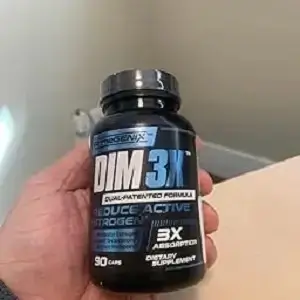
For men using DIM in a gynecomastia prevention or early management context, consistent and reliable DIM absorption is particularly important — and DIM 3X’s formulation is designed to deliver exactly that.
The ingredient profile is transparent, the DIM content per serving is appropriate for the use case, and the product is clearly targeted at the male hormonal health audience.
As with all branded supplement products, PrimeGENIX DIM 3X as a combined formulation has not been independently evaluated in its own peer-reviewed clinical trial — the standard industry limitation.
Individual responses will vary based on baseline estradiol, body composition, TRT status, and the stage of any existing gynecomastia.
If you are considering DIM 3X or any other DIM product for gynecomastia management, discuss it with your physician — particularly if you are on TRT or any other hormone-affecting medication. Click here to check out my detailed Primegenix DIM3X review.
Timing and Cycling
Take DIM with a meal containing healthy fats — DIM is fat-soluble and absorption is meaningfully better with dietary fat present.
Run DIM on an 8 weeks on, 2 weeks off cycle to prevent receptor adaptation and allow periodic hormonal recalibration.
How Long Before Results
For early-stage gynecomastia, most men who respond to DIM report noticeable reduction in breast sensitivity within 4 to 8 weeks — with more visible physical changes, where they occur, typically appearing at 8 to 12 weeks.
If no subjective or objective improvement is evident after a committed 12-week protocol at appropriate dosing, DIM alone is not sufficient for your situation and escalation to pharmaceutical management should be considered.
DIM vs. Other Natural Approaches for Gynecomastia
DIM is the most specific natural tool available for the estrogen metabolic pathway relevant to gynecomastia — but it is not the only natural intervention worth considering.
Here is how the other main options compare and how they fit alongside DIM.
Zinc
Zinc is a direct aromatase inhibitor — it reduces the enzymatic conversion of testosterone to estradiol at the source, working upstream of the metabolic pathway that DIM addresses.
The two mechanisms are complementary rather than redundant — DIM improves how estrogen is metabolized while zinc reduces how much estrogen is produced in the first place.
Combining DIM with zinc at 25 to 40mg per day creates a more comprehensive natural approach to estrogen management than either compound alone.
Calcium D-Glucarate
Calcium D-glucarate supports estrogen clearance through the liver via the glucuronidation pathway — the route by which processed estrogen is packaged for excretion.
When this pathway functions efficiently, estrogen that has already been metabolized is cleared more rapidly, reducing total estrogenic load.
Adding 500mg of calcium D-glucarate to a DIM protocol creates a three-pathway approach: reduced production (zinc), improved metabolism (DIM), and enhanced clearance (calcium D-glucarate).
Body Fat Reduction
This is not a supplement — but it deserves prominence because it is the single most impactful natural intervention for hormone-driven gynecomastia in overweight men.
Adipose tissue is the primary site of aromatase activity in men, and reducing body fat directly reduces the enzymatic conversion of testosterone to estradiol at its biological source.
No supplement stack produces hormonal ratio improvements as significant as meaningful fat loss in men who are significantly overweight — and DIM works better in a leaner body than a fatter one.
Dietary Cruciferous Vegetables
Eating broccoli, cauliflower, and kale regularly provides dietary indole-3-carbinol that partially converts to DIM in the gut.
At normal dietary portions, the amount of DIM produced is far below what is therapeutically relevant for gynecomastia management — but it contributes to the overall estrogen management picture and has zero risk.
DIM vs. Pharmaceutical Options for Gynecomastia Management
At some point in the gynecomastia conversation, pharmaceutical options enter the frame.
Understanding where DIM sits relative to these options — and when each is more appropriate — is essential for making an informed decision.
DIM vs. Anastrozole
Anastrozole is a pharmaceutical aromatase inhibitor that directly blocks the aromatase enzyme, producing dramatic reductions in estradiol levels.
It is significantly more powerful than DIM for estrogen reduction — but that power comes with the risk of estrogen over-suppression, producing joint pain, mood instability, bone density loss, and libido dysfunction when levels drop too low.
DIM’s modulating mechanism is inherently less prone to this over-suppression risk — which is exactly why many TRT practitioners are moving toward a DIM-first approach, escalating to anastrozole only when DIM is insufficient.
DIM vs. SERMs
Selective estrogen receptor modulators like tamoxifen and raloxifene work by blocking estrogen receptors in breast tissue directly — preventing estrogen from binding regardless of how much estrogen is circulating.
This is a fundamentally different mechanism from DIM, which works on estrogen metabolism rather than receptor blockade.
SERMs are significantly more powerful for acute gynecomastia intervention — they are the pharmaceutical first choice for early-stage gynecomastia management and have better evidence than DIM for this specific application.
The honest comparison is this: if you have confirmed early gynecomastia and are willing to use pharmaceutical management, tamoxifen has better evidence for gynecomastia specifically than DIM.
If you are committed to a natural approach or are using DIM preventively, DIM’s risk profile is considerably more benign than any pharmaceutical option.
The Hybrid Approach
Some practitioners combine DIM with low-dose pharmaceutical AI to achieve better estrogen management than either alone, while reducing the pharmaceutical dose required and therefore reducing side effect risk.
This approach allows DIM to handle the metabolic optimization component while the pharmaceutical handles the production reduction component — a division of labor that can produce better overall hormonal balance than maximizing either intervention alone.
When Surgery Is the Only Answer
For established, fibrotic gynecomastia — regardless of how good your hormonal management is — surgery is the only definitive solution.
No supplement, no pharmaceutical, no hormonal intervention can remove fibrotic glandular tissue. That is a physical reality, and any honest discussion of gynecomastia management has to include this fact prominently.
Potential Side Effects of DIM Relevant to Gynecomastia Treatment
Men using DIM specifically for gynecomastia management need to be aware of a few side effects that are particularly relevant in this context.
Most are manageable — but one in particular deserves careful attention.
Paradoxical Early Breast Sensitivity
Some men notice increased nipple sensitivity or breast tenderness in the first one to two weeks of starting DIM.
This is counterintuitive for men taking DIM specifically to address gynecomastia, and it can cause significant alarm — but it is usually a transitional effect related to the initial hormonal flux as estrogen metabolism begins to shift.
For most men, this sensitivity resolves within two to three weeks as the body adapts. However, if it worsens or persists beyond four weeks, stop DIM and reassess with a physician.
Estrogen Over-Suppression
While DIM is significantly less likely to over-suppress estrogen than pharmaceutical aromatase inhibitors, it is not impossible — particularly at higher doses in men who are already at the lower end of the normal estradiol range.
Symptoms of over-suppression include significant joint pain, complete loss of libido, emotional flatness, and severe fatigue — these should prompt immediate dose reduction and blood work assessment.
Dark Urine
Dark or amber-colored urine is one of the most commonly reported DIM side effects and is caused by the excretion of DIM metabolites through the kidneys.
In the absence of accompanying pain, fever, or other symptoms, this is generally harmless — it is a sign that DIM is being absorbed and processed, not a sign of kidney damage.
The Thyroid Caution
Men with pre-existing thyroid conditions should not use DIM without physician supervision, as DIM can interact with thyroid hormone metabolism through shared CYP enzyme pathways.
If you have hypothyroidism or are on thyroid medication, this is a non-negotiable medical conversation before starting DIM for any purpose including gynecomastia.
Building a Complete Gynecomastia Prevention Protocol Around DIM
DIM works best not as a standalone intervention but as part of a comprehensive approach that addresses estrogen at every level — production, metabolism, and clearance.
Here is the complete step-by-step protocol.
Step 1: Establish Your Baseline
Before starting any intervention, get blood work done — at minimum estradiol, free testosterone, SHBG, and a liver function panel.
Without a baseline, you cannot objectively assess whether DIM is working — and you cannot identify any pre-existing issues that might affect your response or safety.
Step 2: Identify and Address the Root Cause
DIM addresses the hormonal environment — but it cannot fix the underlying cause of that environment.
If your gynecomastia is being driven by obesity, fat loss is the primary intervention. If it is TRT-related, your TRT protocol needs review. If it is medication-related, that conversation needs to happen with your prescribing physician.
Step 3: Implement the Lifestyle Foundation
Body fat reduction, alcohol elimination, and endocrine disruptor reduction (plastic containers, certain personal care products, non-organic produce) all reduce the estrogenic load on your body independent of any supplement.
These changes should be in place before or alongside starting DIM — they amplify DIM’s effectiveness significantly.
Step 4: Start DIM at 200mg Bioavailable Daily
Begin at 200mg of a high-bioavailability DIM product taken with a fatty meal.
Hold this dose for four to six weeks before adjusting — your body needs time to adapt to the shift in estrogen metabolism patterns.
Step 5: Add Complementary Natural Support
Add zinc at 25 to 40mg daily for aromatase inhibition and calcium D-glucarate at 500mg daily for estrogen clearance.
Ensure vitamin D3 is adequate — deficiency correlates with poorer testosterone-to-estrogen ratios — and optimize magnesium for sleep quality and cortisol management.
Step 6: Retest at 6 Weeks
At the six-week mark, repeat your blood work and compare against baseline — looking specifically at estradiol, free testosterone, and SHBG.
If estradiol has reduced meaningfully and free testosterone has improved, you are on the right track. If markers are unchanged, dose adjustment or protocol review is needed.
Step 7: Assess Breast Tissue at 8 to 12 Weeks
By 8 to 12 weeks of committed protocol implementation, early-stage gynecomastia that is responding to DIM should show at least some reduction in sensitivity, softening of tissue, or visible reduction.
No change at 12 weeks despite blood work improvements suggests established fibrosis — at which point honest acceptance that surgical consultation is needed is the appropriate next step.
Step 8: Escalate When Necessary
If DIM alone at an appropriate dose with supporting measures is not producing sufficient results after 12 weeks, pharmaceutical escalation — discussed openly with your physician — is the rational next step.
This is not a failure of the natural approach — it is the protocol working exactly as designed, identifying the point where the severity of the situation exceeds what natural intervention can address.
Conclusion
Gynecomastia is more common than most men want to admit, and the frustration of dealing with it is entirely real.
The hope that DIM represents for men who discover it is genuine — and under the right circumstances, it is justified.
DIM is a meaningful tool for men in the early stages of estrogen-driven gynecomastia — particularly those in high-risk hormonal environments like TRT, aggressive bulking phases, or post-cycle situations.
It works by improving the quality of estrogen metabolism rather than eliminating estrogen, and for breast tissue that is still in the active, hormonally-driven phase, this mechanism can make a real difference.
What DIM cannot do is reverse established fibrotic breast tissue that has passed the active hormonal phase.
It is not a pharmaceutical aromatase inhibitor. And it is definitively not a surgical substitute.
If your gynecomastia has been present for more than 12 to 18 months, feels firm rather than soft, and is not tender or changing — you need a different conversation with a different specialist.
Start with blood work. Identify the root cause. Implement DIM alongside the lifestyle fundamentals that address estrogen at its source. Monitor your response. Escalate when necessary.
And work with a physician who understands hormonal health well enough to guide you through this intelligently.
Your chest — and your confidence — deserve that level of care.