
DIM Supplement for Men on TRT: The Complete Guide to Managing Estrogen on Testosterone Replacement Therapy
If you’re on testosterone replacement therapy, here’s something your doctor may not have told you.
TRT works brilliantly for restoring energy, libido, muscle mass, and mental clarity — but it comes with a significant hormonal side effect that catches most men completely off guard.
The more testosterone you introduce into your body, the more your body converts it to estrogen through a process called aromatization.
And too much estrogen? It can cancel out virtually every benefit you started TRT for in the first place.
Here’s a stat that puts it in perspective: studies suggest that men on TRT can see estradiol levels rise by 50 to 100 percent above their pre-treatment baseline within the first few months of therapy.
That’s especially true for men who carry excess body fat or are genetically prone to high aromatase activity.
That hormonal shift is significant enough to cause gynecomastia, water retention, mood swings, reduced libido, and fatigue — the exact symptoms TRT is supposed to fix.
The good news is that DIM, a natural compound derived from cruciferous vegetables, has emerged as one of the most popular tools men on TRT use to keep estrogen in check without resorting to pharmaceutical aromatase inhibitors.
But does it actually work? And more importantly, how do you use it correctly alongside your TRT protocol?
That’s exactly what we’re going to answer in this guide — comprehensively, honestly, and with the science to back it up.
Why Estrogen Management Is Critical for Men on TRT
Most men start TRT thinking about one thing: getting their testosterone up.
What they don’t anticipate is the estrogen problem that comes with it.
How TRT Raises Estrogen
When you introduce exogenous testosterone into your body, your aromatase enzyme doesn’t distinguish between natural and injected — it converts all of it.
The more testosterone in circulation, the more raw material that enzyme has to work with, and the more estradiol it produces.
This is not a flaw in TRT. It’s simply your body’s normal hormonal response to elevated testosterone levels.
The problem is that the speed and volume of that conversion on TRT often exceeds what the body would naturally produce, pushing estradiol into a range that causes real, noticeable symptoms.
Symptoms of High Estrogen on TRT
Gynecomastia — the development of breast tissue — is the most feared symptom, and it’s entirely real.
Beyond that, high estrogen on TRT causes water retention that blunts muscle definition, mood instability that feels like emotional volatility, brain fog that undermines cognitive performance, and a paradoxical reduction in the libido that TRT was supposed to restore.
Many men assume these symptoms mean TRT isn’t working for them.
In most cases, it’s not the testosterone that’s the problem — it’s the unmanaged estrogen running alongside it.
The Testosterone-to-Estradiol Ratio
The key isn’t just absolute estradiol levels — it’s the ratio between testosterone and estradiol.
A man with total testosterone of 800 ng/dL and estradiol of 40 pg/mL may feel excellent, while the same estradiol in a man with lower testosterone could cause significant issues.
This is exactly why blanket estrogen management guidelines don’t work for everyone.
Your individual ratio, your symptoms, and your blood work together determine what level of estrogen management — if any — you actually need.
The Conventional Approach and Its Drawbacks
Pharmaceutical aromatase inhibitors like anastrozole (Arimidex) are the standard medical tool for managing estrogen on TRT.
They work — but they work bluntly, with a high risk of crashing estrogen below healthy levels, which creates its own set of serious problems including joint pain, bone density loss, severe mood depression, and cognitive impairment.
This is precisely why so many men on TRT are looking for a gentler, more nuanced approach to estrogen management.
DIM is the natural option that most frequently comes up in that conversation.
What Is DIM and How Does It Help Men on TRT?
DIM stands for Diindolylmethane.
It’s a naturally occurring compound produced in your body when you digest cruciferous vegetables — broccoli, cauliflower, kale, cabbage, Brussels sprouts — through the breakdown of a precursor compound called indole-3-carbinol.
How DIM Works
DIM does not block estrogen production the way anastrozole does.
Instead, it works by influencing which metabolic pathway estrogen takes as it’s broken down — steering it toward the 2-hydroxyestrone pathway (the beneficial form) and away from the 16-alpha-hydroxyestrone pathway (the more problematic form).
Think of it less as a blocker and more as a metabolic redirector.
It doesn’t remove estrogen from your body — it helps your body process it in a healthier way.
Why DIM’s Gentler Mechanism Matters on TRT
Because DIM modulates rather than blocks, it carries a significantly lower risk of crashing your estrogen.
For men on TRT who need estrogen support but don’t want to risk the side effects of over-suppression, that distinction is everything.
DIM also appears to support free testosterone by influencing sex hormone binding globulin (SHBG) — the protein that binds testosterone and renders it unavailable to tissue.
Lower SHBG means more of your TRT testosterone is actually free and active in your body, which amplifies the benefits you’re paying for.
What the Science Says
The research on DIM for men specifically on TRT is still developing, but the underlying mechanisms — DIM’s effect on estrogen metabolism and the CYP1A1/CYP1B1 enzyme pathways — are well-documented in peer-reviewed literature.
The clinical evidence base for DIM’s general estrogen-modulating effects in humans is meaningful, particularly for its role in healthy estrogen metabolism and phase I liver detoxification support.
DIM vs Anastrozole for Men on TRT — Which Is Better?
This is the comparison that almost every man on TRT eventually makes.
Both DIM and anastrozole aim to address the same problem — elevated estrogen on TRT — but they do it in fundamentally different ways, with very different risk profiles.
How Anastrozole Works
Anastrozole is a pharmaceutical aromatase inhibitor — it binds to the aromatase enzyme and directly blocks its ability to convert testosterone to estradiol.
The result is a measurable, often dramatic reduction in estradiol levels — which is exactly what you want, until it goes too far.
The Risk of Over-Suppression With Anastrozole
The dose-response curve on anastrozole is steep.
Small increases in dose can push estradiol from the optimal range into the dangerously low range with surprising speed, producing joint pain that feels arthritic, mood crashes that can be severe, significant reductions in bone mineral density over time, and libido that disappears completely.
This is not a theoretical risk — it’s one of the most commonly reported complaints in TRT communities worldwide.
Many men report feeling worse on TRT with anastrozole than they did before starting therapy at all.
Where DIM Fits
DIM’s modulating mechanism makes it inherently safer from an over-suppression standpoint.
Because it influences metabolic pathways rather than blocking enzyme function directly, it’s much harder to accidentally crash your estrogen with DIM than with anastrozole.
For men with moderately elevated estradiol — say, levels in the 40 to 60 pg/mL range on TRT — DIM is often sufficient to produce meaningful improvement without the risk profile of a pharmaceutical.
For men with clinically high estradiol — above 80 to 100 pg/mL — anastrozole may still be necessary, but DIM can potentially allow for a lower anastrozole dose with better overall balance.
The Hybrid Approach
A growing number of TRT physicians are adopting a DIM-first philosophy — using DIM as the initial estrogen management tool and reserving anastrozole for cases where DIM alone proves insufficient.
This approach reduces pharmaceutical exposure, lowers over-suppression risk, and still provides meaningful estrogen management for the majority of men on standard TRT protocols.
The Right DIM Dosage for Men on TRT
Dosing DIM on TRT is different from general DIM supplementation.
You’re managing estrogen in a pharmacologically elevated testosterone environment, which means the aromatization load is higher and your DIM dosage needs to reflect that.
Recommended Dosage Range for TRT Men
For men on TRT, the generally cited dosage range for DIM is 200 to 400mg per day — notably higher than the 100 to 200mg commonly recommended for men with natural testosterone levels.
Starting at 200mg per day and adjusting based on blood work and symptom response is the most sensible approach.
Why Bioavailability Is Non-Negotiable on TRT
Plain DIM capsules without bioavailability enhancement are poorly absorbed — research suggests only a small fraction of unenhanced DIM actually reaches systemic circulation.
On TRT, where you need consistent, reliable dosing to manage elevated aromatization, a bioavailable form of DIM is not optional — it’s essential.
Look specifically for formulations that include BioPerine (black pepper extract), phosphatidylcholine, or sunflower lecithin.
These ingredients dramatically improve how much DIM actually reaches your bloodstream, meaning you need less of it to achieve the same effect.
How TRT Dose Affects DIM Requirements
Men on higher TRT doses — 200mg per week or above — generally aromatize more and may need doses toward the higher end of the 200 to 400mg range.
Men on lower TRT protocols — 100 to 150mg per week — may find that 200mg of bioavailable DIM is entirely sufficient.
Body fat percentage is equally important — higher body fat increases aromatase activity, meaning heavier men on TRT typically need more DIM support than leaner men on the same protocol.
This is why blood work is the only reliable way to calibrate your dose — there’s no universal formula that accounts for all these variables.
Timing Your DIM Dose
Take DIM with food — ideally a meal containing some dietary fat, since DIM is fat-soluble and absorbs significantly better in the presence of fat.
Most men on TRT do well taking DIM once daily in the morning, though some prefer splitting the dose between morning and evening, particularly at higher doses.
Blood Work and Monitoring on DIM and TRT
If there’s one thing that separates men who thrive on TRT from men who struggle with it indefinitely, it’s this: the ones who thrive test their blood regularly.
Adding DIM to your protocol without monitoring your blood work is guesswork — and guesswork with your hormones has real consequences.
What to Test
At minimum, your hormone panel should include total testosterone, free testosterone, estradiol (E2), and sex hormone binding globulin (SHBG).
A complete picture also includes LH and FSH (to confirm suppression from TRT), hematocrit (red blood cell concentration — a known TRT risk factor), a comprehensive metabolic panel (liver and kidney function), and a lipid panel.
Optimal Estradiol Ranges on TRT
The conventional target of 20 to 30 pg/mL estradiol that many TRT protocols cite is increasingly being questioned by experienced practitioners.
Many men feel best — in terms of libido, mood, energy, and joint health — with estradiol in the 30 to 50 pg/mL range when testosterone is in the optimal zone.
The ratio between your testosterone and estradiol is what matters most.
Chasing an arbitrary absolute estradiol number without considering your testosterone level is a mistake that leads to unnecessary estrogen suppression.
When to Test After Starting DIM
Get baseline blood work before starting DIM — this gives you a reference point to measure against.
Retest at six weeks after starting DIM to assess the impact on your estradiol, free testosterone, and SHBG.
After that, quarterly testing is appropriate for most stable TRT patients.
If you adjust your TRT dose or DIM dose, retest at six weeks from the change.
Communicating With Your TRT Physician
Always inform your prescribing physician that you’re using DIM alongside your TRT.
DIM is a biologically active compound that influences the same hormonal pathways your TRT physician is managing — they need to know about it to interpret your blood work accurately and make informed prescribing decisions.
Benefits of DIM for Men on TRT Beyond Estrogen Management
Most men start taking DIM on TRT for one reason: estrogen control.
What they often discover is a range of additional benefits that make DIM genuinely valuable as a long-term addition to their protocol.
Improved Body Composition
Estrogen is one of the primary drivers of subcutaneous fat storage in men, particularly around the abdomen and chest.
When DIM helps rebalance your estrogen metabolism on TRT, many men report noticeable improvements in body composition — less water retention, better muscle definition, and reduced difficulty shifting abdominal fat.
Prostate Health Protection
Elevated estrogen on TRT stimulates estrogen receptors in prostate tissue, which has long-term health implications.
DIM’s role in steering estrogen metabolism toward less proliferative pathways means it may offer a meaningful protective effect on prostate tissue for men on long-term TRT.
Mood and Emotional Stability
One of the most underappreciated side effects of unmanaged estrogen on TRT is mood instability — emotional volatility, irritability, and anxiety that feels out of character.
Men who successfully manage their estrogen with DIM frequently report that this aspect of their TRT experience improves significantly — more emotional stability, better stress resilience, and a greater sense of overall wellbeing.
Sleep Quality
Both elevated estrogen and testosterone imbalance affect sleep architecture — the quality and depth of sleep cycles.
Achieving better estrogen balance through DIM often correlates with improved sleep quality, including deeper, more restorative sleep and fewer nighttime waking episodes.
Libido and Sexual Function
The sweet spot for male sexual function isn’t maximum testosterone — it’s the optimal ratio of testosterone to estrogen.
When both hormones are in balance, libido, erectile function, and sexual confidence typically reach their peak — and DIM’s role in supporting that balance makes it a meaningful contributor to sexual health on TRT.
Cognitive Clarity
Brain fog is a common complaint in men with unmanaged estrogen on TRT — and it’s one that responds well to estrogen optimization.
Many men report that once their testosterone-to-estrogen ratio is properly managed with DIM, their mental sharpness, focus, and cognitive energy return to where they expected TRT to take them in the first place.
How to Add DIM to Your TRT Protocol — Step by Step
Adding DIM to your TRT protocol doesn’t need to be complicated.
But it does need to be done systematically — because changing too many variables at once makes it impossible to know what’s working and what isn’t.
Step 1: Establish Your Baseline
Before you take your first DIM capsule, get a full hormone panel done.
You need to know your pre-DIM estradiol, free testosterone, and SHBG so you have something meaningful to compare your six-week results against.
Step 2: Choose a Quality, Bioavailable Product
As discussed, plain DIM without bioavailability enhancement is inadequate for TRT-level estrogen management.
Select a product that contains at minimum 200mg of DIM per serving and includes a proven absorption enhancer such as BioPerine, phosphatidylcholine, or sunflower lecithin.
One product worth considering in this space is PrimeGENIX DIM 3X.
It is specifically formulated for men’s hormonal health and features a patented absorption system designed to maximize how much DIM reaches systemic circulation — a particularly relevant feature for TRT users who need consistent, reliable dosing to manage elevated aromatization.
As with any supplement, it has not been evaluated in independent peer-reviewed clinical trials as a combined formula, and individual results will vary based on TRT dose, body composition, and baseline hormonal status.
Treat any DIM product, including DIM 3X, as one tool within a broader, medically supervised TRT strategy.
Step 3: Start at 200mg Daily With Food
Begin with 200mg per day taken with a meal — consistency matters more than timing.
Hold this dose for four to six weeks before making any adjustments.
Step 4: Track Your Symptoms Weekly
Keep a simple weekly log of your key subjective markers: energy levels, libido, mood, water retention, gym performance, and sleep quality.
This creates a personal data trail that helps you interpret your blood work in context rather than in isolation.
Step 5: Retest Blood Work at Six Weeks
At the six-week mark, repeat your hormone panel and compare estradiol, free testosterone, and SHBG against your baseline.
If estradiol has moved toward your target range and symptoms have improved, you’re on the right track.
Step 6: Adjust Based on Data
If estradiol remains high and symptoms persist, increase DIM to 300mg and retest at six weeks.
If estradiol has dropped below your target range or you’re experiencing low estrogen symptoms — joint pain, mood flatness, complete absence of libido — reduce your dose and retest.
Step 7: Keep Your Physician Informed
Document your DIM supplementation in your TRT records and discuss it with your prescribing physician at your next review.
Your doctor needs accurate information about everything you’re taking to manage your protocol safely and interpret your lab results accurately.
DIM Supplement Side Effects Specific to Men on TRT
Men on TRT experience DIM side effects somewhat differently from men with natural testosterone levels.
Understanding these differences helps you distinguish between expected adjustment reactions and genuine warning signs.
The Estrogen Crash Risk Is Higher on TRT
Because TRT already elevates testosterone significantly, even a moderate reduction in aromatase activity from DIM can produce a proportionally larger drop in estradiol than it would in a man with natural testosterone levels.
This makes over-suppression of estrogen more likely on TRT, particularly at higher DIM doses — which is another reason why starting at 200mg rather than jumping to 400mg is the right approach.
The Adjustment Period
Most men experience some degree of hormonal flux in the first two to four weeks after adding DIM to their TRT protocol.
Temporary libido fluctuation, mild mood shifts, and changes in energy levels are all common during this window and generally resolve as the body adjusts to the new hormonal environment.
Do Not Change TRT Dose and DIM Simultaneously
This is one of the most important practical rules for TRT management in general, and it applies directly to DIM.
If you change your TRT dose at the same time you add DIM, you have no way of knowing which change produced which outcome — you’ve lost the ability to isolate variables, which makes rational protocol management impossible.
Red Flags That Require Medical Attention
If you experience significant joint pain, severe mood depression, complete loss of libido, or any symptoms that feel disproportionate to a normal supplement adjustment, stop DIM and contact your TRT physician.
These symptoms suggest possible estrogen over-suppression and require blood work to assess — not a wait-and-see approach.
DIM and Hematocrit
There is no well-established evidence that DIM directly affects hematocrit — the red blood cell concentration that TRT can elevate above healthy ranges.
However, continue monitoring hematocrit in your regular TRT blood work as standard practice, regardless of DIM use.
Best DIM Supplements for Men on TRT — What to Look For
On TRT, the quality of your DIM supplement matters more than in any other context.
You’re using it to manage a pharmacologically elevated hormonal environment — inconsistent absorption or underdosed products simply won’t produce the reliable estrogen management you need.
Bioavailability Is the Most Important Factor
This bears repeating: plain DIM without absorption enhancement is inadequate for TRT-level estrogen management.
The difference in absorption between enhanced and unenhanced DIM formulations is significant enough to render the cheaper, simpler products functionally ineffective at doses that would otherwise be therapeutic.
What to Look For on the Label
Minimum 200mg of DIM per serving — this is non-negotiable for TRT users.
A named bioavailability enhancer such as BioPerine (standardized piperine extract), phosphatidylcholine, or sunflower lecithin should appear clearly in the ingredient list.
Third-party testing or GMP certification gives you confidence that the product contains what it claims to contain at the dose it claims to contain it.
Avoid products that list DIM as part of a proprietary blend without disclosing the specific DIM content — you have no way of knowing how much you’re actually getting.
PrimeGENIX DIM 3X
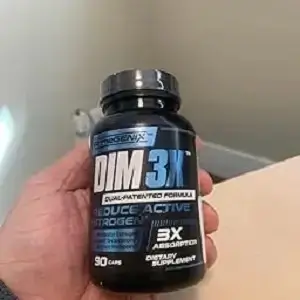
PrimeGENIX DIM 3X is one of the most frequently discussed DIM products in TRT circles, and it’s easy to understand why.
It is formulated specifically with men’s hormonal health in mind, features a patented absorption-enhancing technology, and provides a meaningful dose of DIM per serving.
Its ingredient profile is transparent, its absorption system addresses the core limitation of generic DIM products, and its formulation is targeted at exactly the kind of men — active, hormonally aware, seeking natural support for their protocol — who are most likely to be reading this.
That said, it has not been studied as a standalone formula in independent peer-reviewed clinical trials, which is the standard limitation of virtually all branded supplement products.
Results will vary based on individual factors including TRT protocol, body composition, diet, and baseline estradiol.
Check Primegenix DIM3X complete review by clicking here
Consistency Matters More Than Brand
Whatever product you choose, take it every single day.
DIM’s estrogen-modulating effects are cumulative and dependent on consistent supplementation — skipping doses regularly will produce inconsistent results that make it impossible to assess whether DIM is actually working in your protocol.
Conclusion
Managing estrogen on TRT is not optional.
It’s the difference between a protocol that genuinely transforms your health, energy, and quality of life — and one that leaves you frustrated, symptomatic, and wondering why you bothered.
DIM offers men on TRT a gentler, more nuanced approach to estrogen management than pharmaceutical aromatase inhibitors.
For many men, it’s exactly the right tool — effective enough to produce meaningful estrogen modulation, gentle enough to avoid the estrogen crash risk that makes anastrozole so problematic.
But let’s be completely clear about what DIM is and isn’t on TRT.
It’s not a replacement for blood work. It’s not a substitute for medical supervision. And it’s not appropriate for every man on TRT — those with clinically very high estradiol may need pharmaceutical intervention regardless of how well-optimized their DIM protocol is.
What DIM is, when used correctly, is a smart, evidence-informed addition to a well-managed TRT protocol.
It supports estrogen balance, free testosterone levels, prostate health, mood stability, body composition, and overall hormonal wellbeing.
Start with your baseline blood work. Choose a quality, bioavailable product. Take it consistently with food. Retest at six weeks. Adjust based on data, not guesswork. Tell your doctor what you’re doing.
That protocol — simple as it sounds — is what separates the men who thrive on TRT from those who struggle with it indefinitely.
Your hormones respond to precision. Give them that, and TRT becomes everything it was supposed to be.