DIM Estrogen Blocker for Men : Complete Dosage Guide and Benefits 2026
How much DIM should a man take, and does it block estrogen? Human studies have used doses above 300 mg a day in men with prostate cancer, but no dose has been established for estrogen control in healthy men. Nor is there a proven 8-to-12-week timeframe for judging a benefit.
On the second half of that question: DIM is not an estrogen blocker. It does not switch off aromatase the way a prescription aromatase inhibitor does. What it changes is the route your body uses to break estrogen down, pushing it toward the weaker 2-hydroxyestrone pathway.
That shift is well documented. Whether it improves how a healthy man looks, feels or performs has not been tested in a published trial, so blood work before and after — total testosterone, free testosterone, SHBG and a sensitive estradiol test — is what tells you if it’s doing anything for you.
Did you know that men’s estrogen levels play an important role in their health? This highlights a growing concern in men’s health today.
As environmental exposures, diet, and lifestyle factors may contribute to hormonal imbalances, many men are turning to natural solutions like DIM (diindolylmethane) in the hope of restoring their hormonal equilibrium.
I’ve spent years researching hormone optimization, and one supplement that consistently stands out is DIM estrogen blocker for men.
This powerful compound, derived from cruciferous vegetables, offers a natural approach to managing estrogen levels without completely blocking this essential hormone.
Understanding the proper dosage isn’t just important – it’s crucial for achieving optimal results while maintaining safety!
DIM Is Not an Estrogen Blocker
This is the single most useful thing to understand before you buy any of it. Almost every product label gets it wrong, and the mistake changes what you should expect.
A true estrogen blocker interferes with estrogen itself. Prescription aromatase inhibitors like anastrozole stop the enzyme that converts testosterone into estradiol, so less estrogen gets made in the first place.
DIM has not been shown to inhibit aromatase in men the way a prescription blocker does. Your body may make just as much estrogen on DIM as it did before; a reliable reduction has not been demonstrated.
What changes is the exit route. Estrogen gets broken down along several pathways, and DIM pushes more of that traffic down the 2-hydroxyestrone route, which produces a weaker metabolite.
Potentially the same amount in, different breakdown products out. That is modulation, not blockade.
The practical difference is size of effect. An aromatase inhibitor can crater your estradiol within days, which is exactly why it is prescription-only and easy to misuse.
DIM is far gentler, and that cuts both ways. You are unlikely to do yourself harm quickly, and you are also unlikely to see a dramatic change on a blood test.
If you are weighing it against the alternatives, we cover how it measures up against aromatase inhibitors and the other options men consider in a separate piece.
What DIM Actually Does in the Body
DIM (3,3′-diindolylmethane) is not really something you eat. It forms in your stomach after you eat cruciferous vegetables like broccoli, cabbage and Brussels sprouts.
A compound called indole-3-carbinol breaks apart in stomach acid, and two fragments pair up to make DIM. A supplement skips that step and delivers far more than any plate of vegetables could.
The 2:16 ratio
Estrogen breakdown produces several metabolites. Two matter most here: 2-hydroxyestrone, which is weakly active, and 16α-hydroxyestrone, which is considerably more active.
DIM shifts the balance toward the 2-hydroxyestrone side. Researchers track this as the 2:16 ratio, and a higher number means more of the weak metabolite relative to the strong one.
This effect is the most reliably reproduced finding in the whole DIM literature. It has shown up in a 12-month randomised trial and in a 14-day pilot study in thyroid patients.
A better 2:16 ratio tells you your body is processing estrogen differently. It does not tell you your estradiol fell, and it says almost nothing about your testosterone.
Most marketing treats those as the same thing. They are not, and the distance between them is where the exaggeration lives.
We go through that specific question — whether any of this improves the testosterone-to-estrogen balance — in our deeper look at the ratio itself.
How Much DIM Should a Man Take?
Start from what has actually been given to humans under supervision, rather than what a label suggests. The tested range is narrower than the supplement aisle implies.
| Study or source | Who took it | Daily dose | Length | What was measured |
|---|---|---|---|---|
| Randomised trial, 2017 | 130 women on tamoxifen | 300 mg (150 mg twice daily) | 12 months | 2:16 ratio, SHBG, tamoxifen metabolites |
| Pilot study, 2011 | Thyroid proliferative disease patients | 300 mg | 14 days | 2:16 ratio, DIM in thyroid tissue |
| Phase I dose-escalation | Men with prostate cancer | 150 to 600 mg (75–300 mg twice daily) | Escalating | Tolerability, anti-androgen activity |
| Rat study, 2016 | Male rats | 10 to 100 mg/kg | 53 days | Sperm quality, testicular tissue |
| Typical supplement | General consumers | 100 to 200 mg | Open-ended | Nothing — not a study |
Some people begin at 100 mg a day and hold it for two to three weeks. There is no benefit to rushing, and a low start may tell you whether you tolerate it initially, although it cannot establish long-term safety.
If you are fine, 200 mg may seem a reasonable place to settle. That sits inside the single-dose range researched in healthy volunteers and matches what the better-formulated products provide in a single capsule, but it is not an established effective daily dose.
Going above 300 mg puts you outside the single-dose range studied in healthy men, although higher daily doses have been studied in cancer patients. The rat data showing dose-dependent damage to sperm quality are a reason to treat the top of the range with suspicion rather than ambition, although those animal doses cannot establish a human threshold.
Take it with fat
DIM is fat-soluble and absorbs poorly on its own. Taking it with a meal containing some fat makes a measurable difference to how much reaches your bloodstream.
Formulas with absorption enhancers such as BioPerine or AstraGin are addressing the same problem. We cover when in the day to take it and how to get the most absorption separately.
Benefits: What Holds Up and What Doesn’t
This is where most DIM articles stop being useful. The claim list is long, and almost none of it comes from trials in healthy men.
Here is the honest breakdown.
| Claim | What the research says | Evidence in men |
|---|---|---|
| Shifts estrogen metabolism | Reproduced across multiple human studies, including a 12-month trial | Established |
| Changes SHBG | Yes — it went up about 25 nmol/L, which is not the direction most buyers want | Shown, in women |
| Improves the T:E ratio | No published randomized trial has measured this in healthy men | Untested |
| Builds muscle or strength | No trial has measured lean mass or strength on DIM in healthy men | Untested |
| Improves fat loss | No body-composition trial exists in this population | Untested |
| Raises energy or mood | Reported anecdotally; no controlled data | Untested |
| Improves libido | DIM is characterised as anti-androgenic in prostate cancer research; its effects on libido in healthy men remain untested | Untested |
| Prostate benefit | Under active investigation; a 2020 review of 22 trials found no proof of treatment effect | Investigational |
The SHBG problem
You will read that DIM frees up testosterone by lowering SHBG. The best controlled data says the opposite.
In a randomized, placebo-controlled trial, participants taking 300 mg of DIM daily saw SHBG climb by roughly 25 nmol/L. The placebo group moved about 1 nmol/L.
These were women on tamoxifen, so men may respond differently. But SHBG binds testosterone, so if DIM caused a rise of that size in men, it could pull free testosterone down, not up.
This is why total testosterone alone will mislead you here. You need free testosterone and SHBG on the same panel to see what is actually happening.
The muscle claim specifically
No study has put DIM into healthy lifters and measured lean mass. The argument for it is entirely theoretical: better estrogen profile, therefore better physique.
The anti-androgen finding cuts against that theory directly. We examine what can and cannot be said about DIM and lean mass in its own article.
Testing: The Only Way to Know If It’s Working
Nobody can tell you in advance what DIM will do to your hormones. Your own blood work is the only readout that means anything.
Order the panel before you start, not after you have been taking it for a month.
| Marker | Why it’s on the panel | What would concern you |
|---|---|---|
| Total testosterone | Your baseline reference point | A meaningful fall from baseline |
| Free testosterone | The fraction actually available to your tissues — the number that tracks how you feel | Falling while total stays flat |
| SHBG | The mechanism by which DIM could reduce free testosterone | A clear rise alongside falling free testosterone |
| Estradiol — sensitive (LC-MS/MS) | Standard assays were built for female concentrations and are unreliable in men | Dropping below the male reference range |
| LH and FSH | Shows whether the signal from the pituitary has changed | Movement alongside falling testosterone |
This is the detail most men get wrong. A CDC-led comparison found high variability in estradiol measurement, particularly at the low concentrations normal in men.
A separate study in men found immunoassay readings can be skewed by interference linked to inflammation. Ask specifically for LC-MS/MS, or your whole experiment rests on a number that cannot be trusted.
Insist on the sensitive estradiol test
This is the detail most men get wrong. A CDC-led comparison found high variability in estradiol measurement, particularly at the low concentrations normal in men.
A separate study in men found immunoassay readings can be skewed by interference linked to inflammation. Ask specifically for LC-MS/MS, or your whole experiment rests on a number that cannot be trusted.
How to read the retest
Look at the panel as a whole rather than hunting for a lower estradiol number. Lower is not the goal — appropriate is.
If SHBG rose and free testosterone fell, DIM is working against you regardless of what the estradiol line says. Reduce the dose or stop, and take the results to your doctor.
Stop and retest if you notice:
- Aching joints, especially knees, wrists and elbows
- A clear drop in libido, or erections getting worse
- Flat or low mood that does not match anything else going on
- Night sweats, or sleep that deteriorated around the same time
Men need estradiol. In a 400-man trial, blocking it raised body fat and contributed to worse sexual function — the opposite of why anyone takes an estrogen product.
Side Effects, Interactions and Who Should Avoid DIM
Most men tolerate normal doses without much trouble. In the phase I prostate cancer trial, DIM was well tolerated across every dose tested.
The common complaints are darker urine, mild headaches and an unsettled stomach in the first fortnight. These usually pass, and are a reason to stop if they don’t.
| Situation | The concern |
|---|---|
| Taking tamoxifen or hormone therapy | DIM lowered tamoxifen’s active metabolites in the 2017 trial, which could weaken the drug |
| Trying to conceive | Rat data showed dose-dependent harm to sperm quality; not proof in humans, but a reason to wait |
| Prostate cancer, or on androgen blockers | DIM has anti-androgen activity — use only under oncology guidance |
| On liver-metabolised prescriptions | DIM affects enzymes that also clear many common medications |
| Competing in drug-tested sport | WADA bans aromatase inhibitors and other anti-estrogenic substances under S4; DIM is not named, but supplements can be contaminated |
For the fuller picture, including what the dose-dependent effects look like, see the complete rundown of what can go wrong.
If you are on TRT
Do not use DIM as a substitute for your clinician’s estrogen plan. Changes to SHBG and estradiol affect how your dose should be managed.
Tell your prescriber before adding it, so your labs make sense to both of you. We cover the specific considerations for men already on prescribed testosterone in more depth.
Choosing a DIM Supplement: Our Pick Is PrimeGENIX DIM 3X
Best DIM Supplement for Men (Our Pick): PrimeGENIX DIM 3X
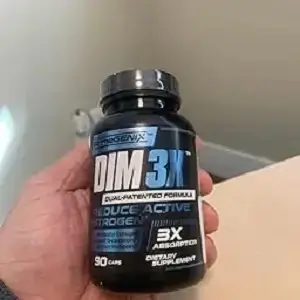
If you’ve decided to try DIM, the product matters. DIM absorbs poorly, and many brands bury the dose inside a proprietary blend. PrimeGENIX DIM 3X is our pick because it gets the basics right: a clearly stated 200 mg of DIM per capsule, within the range used in human studies, made in an FDA-registered, cGMP-certified facility in the US.
It works the way we described earlier in this article: DIM shifts estrogen breakdown toward the weaker 2-hydroxyestrone pathway. That’s modulation, not blockade, so don’t expect it to act like a prescription aromatase inhibitor or to move your estradiol number dramatically.
Why it’s our pick
- 200 mg DIM in one daily capsule — a clearly stated dose within researched ranges
- Supports healthy estrogen metabolism (the 2:16 shift is the most reproduced finding in DIM research)
- Formulated to address DIM’s poor absorption
- Made in the USA in a cGMP-certified facility
- Money-back guarantee, so you can judge it against your own blood work
How to use it: Take it with a meal containing some fat — this improves absorption and helps with the mild stomach upset some men notice in the first couple of weeks. Get a baseline panel before you start (total and free testosterone, SHBG, sensitive LC-MS/MS estradiol) and retest after 8–12 weeks. If SHBG rises while free testosterone falls, stop.
Check with your doctor first if you’re on TRT, tamoxifen, prostate treatment or liver-metabolised medication, or if you’re trying to conceive.
No DIM product has a trial behind the finished formula, so a good product means a well-made, honestly labelled one — not a proven one. Individual results vary.
One caveat worth stating plainly. No DIM product has a trial behind the finished formula, so a good product means a well-made, honestly-labelled one — not a proven one.
Frequently Asked Questions
Is DIM actually an estrogen blocker?
No. DIM has not been shown to inhibit aromatase or reliably reduce how much estrogen you produce in men.
It changes which metabolites your body produces when it breaks estrogen down. The “blocker” label is marketing shorthand, not pharmacology.
How much DIM should I take per day?
Human studies have used more than 300 mg daily in men with prostate cancer. Starting at 100 mg and settling around 200 mg with a meal may fall within studied dose ranges, but neither is an established effective dose for hormone balance in healthy men.
How long before DIM does anything?
Metabolite changes appeared within 14 days in one pilot study. For anything you would notice, or see across a full hormone panel, give it 8 to 12 weeks and then retest.
Will DIM raise my testosterone?
There is no evidence that it does in healthy men. The one controlled trial measuring SHBG was in women on tamoxifen and saw it rise, which could reduce free testosterone if the same happened in men.
Does DIM lower estradiol on a blood test?
Not reliably. It changes how estrogen is metabolised, so serum estradiol can barely move even when the 2:16 ratio improves.
Can I just eat broccoli instead?
Eating more cruciferous vegetables is a genuinely good habit and does supply some DIM. Matching a 200 mg supplement dose from food alone would take an impractical amount.
Is 300 mg too much?
It has been used in human trials, so it is not uncharted. There is no evidence it outperforms 200 mg in healthy men, and the rat data on sperm quality argues against pushing higher for its own sake.
Can I take DIM with other supplements?
Usually, though stacking several hormone-adjacent products at once makes it impossible to tell which one caused a change in your labs. Add one variable at a time.
The Bottom Line
DIM is a real compound with a real, reproducible effect on estrogen metabolism. It is not an estrogen blocker, and the gap between those two statements explains most of the disappointment men report with it.
If you want to try it, 100 to 200 mg with food for 8 to 12 weeks is sometimes suggested, but it is not an established protocol. Discuss it with your clinician, including whether to bracket it with proper blood work measuring free testosterone, SHBG and sensitive estradiol.
Let the panel decide whether it stays. The label is selling you an outcome no trial in healthy men has demonstrated.
And the unglamorous part still matters most. Losing excess fat, lifting consistently, sleeping properly and drinking less will move your hormones further than any capsule on the shelf.
References
- Thomson CA, et al. A randomized, placebo-controlled trial of diindolylmethane for breast cancer biomarker modulation in patients taking tamoxifen. Breast Cancer Res Treat. 2017;165(1):97–107. doi.org/10.1007/s10549-017-4292-7
- Rajoria S, et al. 3,3′-Diindolylmethane modulates estrogen metabolism in patients with thyroid proliferative disease: a pilot study. Thyroid. 2011;21(3):299–304. doi.org/10.1089/thy.2010.0245
- Heath EI, et al. A phase I dose-escalation study of oral BR-DIM in castrate-resistant, non-metastatic prostate cancer. Am J Transl Res. 2010. pmc.ncbi.nlm.nih.gov/articles/PMC2923864
- Gee JR, et al. Phase Ib placebo-controlled, tissue biomarker trial of diindolylmethane (BR-DIMNG) in patients with prostate cancer who are undergoing prostatectomy. Eur J Cancer Prev. 2016;25(4):312–320. pubmed.ncbi.nlm.nih.gov/26313229
- Hwang C, et al. Anti-androgenic activity of absorption-enhanced 3,3′-diindolylmethane in prostatectomy patients. Am J Transl Res. 2016;8(1):166–176. pmc.ncbi.nlm.nih.gov/articles/PMC4759426
- Reed GA, et al. Single-dose pharmacokinetics and tolerability of absorption-enhanced 3,3′-diindolylmethane in healthy subjects. Cancer Epidemiol Biomarkers Prev. 2008. pubmed.ncbi.nlm.nih.gov/18843002
- Aksu EH, et al. 3,3′-Diindolylmethane leads to apoptosis, decreases sperm quality, affects blood estradiol 17β and testosterone in male rats. Andrologia. 2016;48(10):1155–65. pubmed.ncbi.nlm.nih.gov/26926141
- Thomson CA, Ho E, Strom MB. Chemopreventive properties of 3,3′-diindolylmethane in breast cancer: evidence from experimental and human studies. Nutr Rev. 2016;74(7):432–443. pubmed.ncbi.nlm.nih.gov/27261275
- Finkelstein JS, et al. Gonadal steroids and body composition, strength, and sexual function in men. N Engl J Med. 2013;369(11):1011–22. pubmed.ncbi.nlm.nih.gov/24024838
- Bhasin S, et al. Testosterone therapy in men with hypogonadism: an Endocrine Society clinical practice guideline. J Clin Endocrinol Metab. 2018;103(5):1715–44. pubmed.ncbi.nlm.nih.gov/29562364
- Vesper HW, et al. High variability in serum estradiol measurements in men and women. Steroids. 2014. sciencedirect.com/science/article/pii/S0039128X13002900
- Ohlsson C, et al. Comparisons of immunoassay and mass spectrometry measurements of serum estradiol levels and their influence on clinical association studies in men. J Clin Endocrinol Metab. 2013. pubmed.ncbi.nlm.nih.gov/23633197
- World Anti-Doping Agency. The Prohibited List. wada-ama.org/en/prohibited-list
References updated October 2026 following medical review by Dr. Joseph Nightingale.